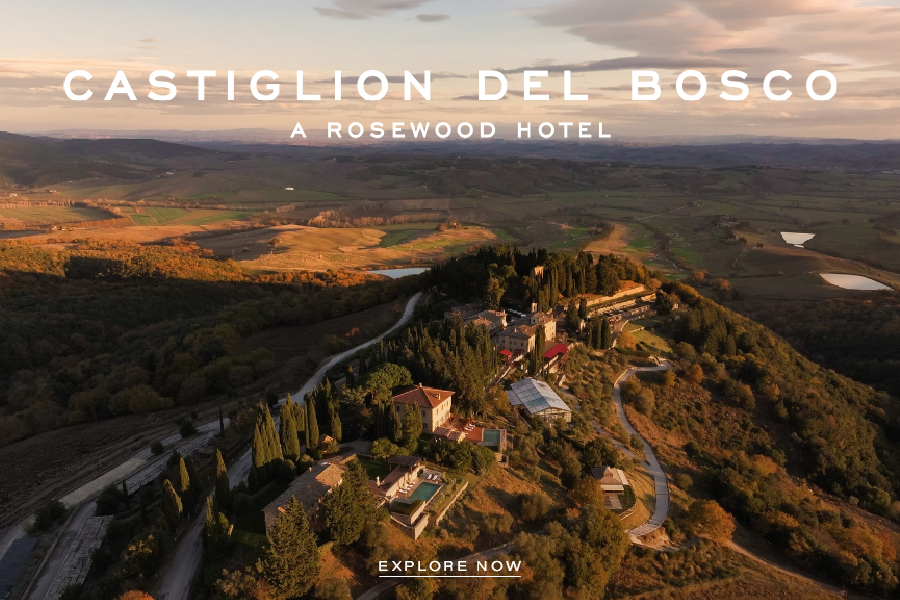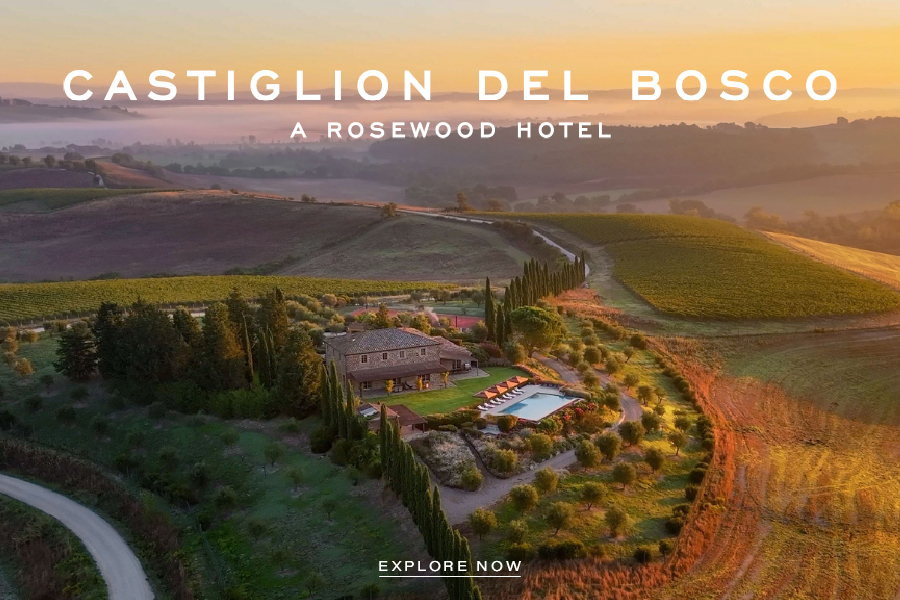
It is November 1, and winter seems to have arrived almost overnight. The sunsets come earlier, but seem to have turned up the intensity, with streaks of almost neon pink cutting across the sky. We’re driving south along the Firenze–Siena highway, the landscape outside the window has taken on an entirely different palette, a cold wind is sweeping across the hills, and the radio announces the season’s first snowfall in the mountains. I squeal with excitement. After surviving one of Italy’s hottest summers, when the only ones who seemed to be enjoying themselves were the mosquitoes, Tuscany’s best season is finally here!
We turn off the main road, following a winding strada bianca towards Castiglion del Bosco. A few kilometres in, rows upon rows of vineyards have turned burnt orange, rust, and deep red, while the cypresses sway in the wind. This is the Tuscany we crave most: after the harvest, after the crowds, when the air is frizzantina, smells of burning wood, and the earth offers up some of its best produce.
Some of which, as we are about to discover, are hiding underground. The next morning, we pull on our boots and head into the woods, following a particularly energetic dog who knows exactly what we’re looking for.
White Truffles: Not Just an Alba Affair
Alba might have won the PR battle, but white truffles aren’t exclusively Piedmontese. Tuscany has its own longstanding tradition, particularly in the Crete Senesi, around San Giovanni d’Asso, a small village in the municipality of Montalcino. So serious is the local obsession that the village has a museum dedicated to truffles and an annual white-truffle market every November.
We head into the woods with the Pittalis family, originally from Sardinia, who have been working with truffles in Montalcino since 1980. Their natural white-truffle reserve covers some 55 acres, although finding one is another matter entirely.
That’s where Aura comes in. Also known as Pulce, she’s an irrepressibly hyper Lagotto Romagnolo, a breed with one of the best noses in the business. Her job is to find the truffles. Ours, apparently, is to get to them before she decides to eat them.
The Pittalis family dispels a few myths along the way. A good truffle isn’t necessarily a big or beautiful one. What matters most is its profumo: a distinctive, intense fragrance. Then there’s the marmorizzazione, the delicate marbling inside the truffle, whose appearance helps identify its species and maturity.
And good truffles start with good soil. They need the right trees and earth that’s humid, soft, and almost sandy. White truffles grow in a symbiotic relationship with tree roots, and unlike several black varieties, they remain notoriously difficult to cultivate reliably. Every year is a bit of Russian roulette: nothing is guaranteed, but that’s part of the thrill and what makes them so precious.
Then comes the question of how to eat one. White truffle should be shaved raw over warm food, never cooked into the dish. And as Chef Siria explains, even olive oil can overpower its delicate aroma, whereas butter helps bring it out. A plate of tagliolini with butter and a generous shaving of white truffle? Sometimes the simplest answer really is the best one.
Brunello: It’s Not Just About the Grapes
By November, the vendemmia is over, the vineyards have turned red and gold, and our attention has shifted from the vines to what’s in the glass.
Montalcino is Brunello country, but what exactly makes a wine a Brunello?
The disciplinare, Italy’s rulebook for wine production, is famously strict. There are dozens of requirements, but three essentials are worth remembering.
First, the place. The grapes must come exclusively from the designated historic production area of Montalcino. Second, the grape. Brunello must be made from 100% Sangiovese, locally known as Brunello. No blending allowed. Third, patience. Brunello cannot be sold before January 1 of the fifth year following the harvest, including at least two years in oak barrels and four months in the bottle.
Brunello Riserva requires even more patience. It can only be released from January 1 of the sixth year after the harvest, a full year later than regular Brunello, and must spend at least six months in the bottle rather than four. Despite what the name might suggest, Riserva doesn’t automatically mean better wine.
Then there’s Rosso di Montalcino, Brunello’s younger sibling, made from the same grape in the same territory but released much earlier, making it a fresher, more immediate expression of Sangiovese.
There are plenty of reasons to drink Brunello year-round, but we struggle to think of a better setting than a cold November evening, a wood fire, and a table full of Tuscan food. Preferably with no plans to get up anytime soon.
Olio Nuovo: That Peppery Kick Is a Good Thing
If Brunello rewards patience, olive oil is quite the opposite.
October and November mark the olive harvest, and with it comes olio nuovo: the season’s freshly pressed extra virgin olive oil. Intensely green, grassy, sometimes bitter, and with a peppery kick that catches at the back of your throat.
Here’s another misconception worth clearing up: that burning sensation isn’t a defect. Bitterness and pungency are actually positive qualities in extra virgin olive oil, linked to its natural phenolic compounds.
Around Montalcino, traditional varieties include Frantoio and Olivastra Seggianese, the latter associated with nearby Monte Amiata.
Our preferred way to enjoy the new harvest? Fettunta, literally fetta unta, or an oiled slice: toasted bread, perhaps rubbed with garlic, and a generous pour of fresh oil. Although ribollita, a crostino with pesto di cavolo nero, or a bowl of warm cannellini beans make equally good excuses.
Then again, in Tuscany, bread and olive oil rarely need an excuse.
And One More Cantuccio…
Autumn makes you appreciate things you barely notice in summer. The smell of damp earth, the first taste of new olive oil, the pleasure of coming inside after a long walk to find a fire already burning.
At Villa Capanna, overlooking the vineyards, lunch unfolds around a wood fire. There are chestnuts roasting, glasses being refilled, and no particular hurry to get anywhere. Not far away, on the slopes of Monte Amiata, chestnuts have been a staple for centuries, once earning the nickname pane dei poveri (the bread of the poor). Today they’re just as welcome roasted over the fire as they are in a slice of castagnaccio.
Tuscan food is particularly well suited to this time of year. The cold, the walks, the truffle hunting, the deer watching: everything seems to work up an appetite.And so we end another meal exactly as we promised ourselves we wouldn’t: already far too full, sitting beside the fire, dipping one more cantuccio into a glass of Vin Santo, and discussing what we’re going to eat tomorrow.