Mustard-yellow plains stretch for miles, giving way to green hills studded with black rocks that point towards azure skies. Beneath them, layers of white stone, deep red dirt, and brown soil reveal the colors of central Sardinia.
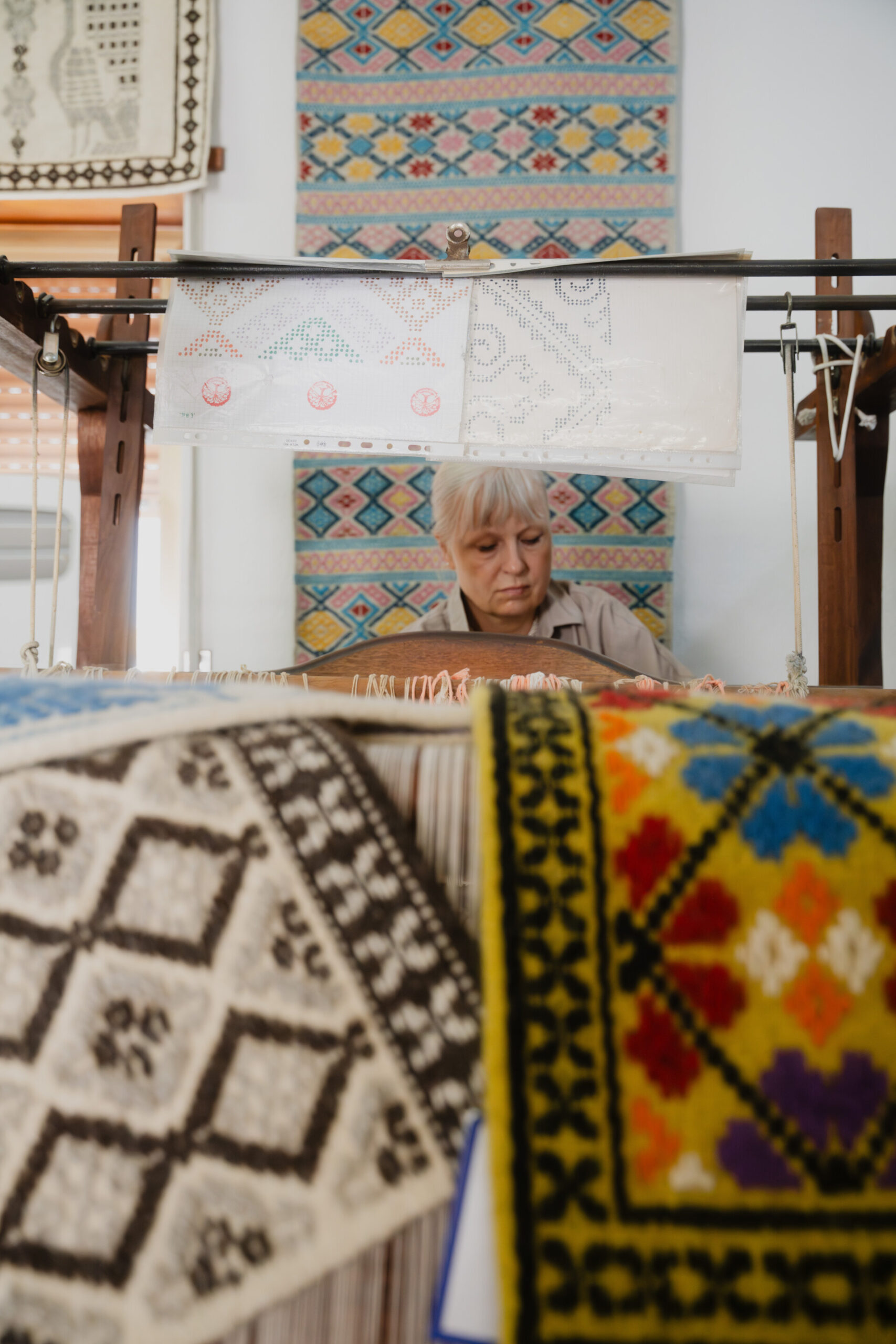
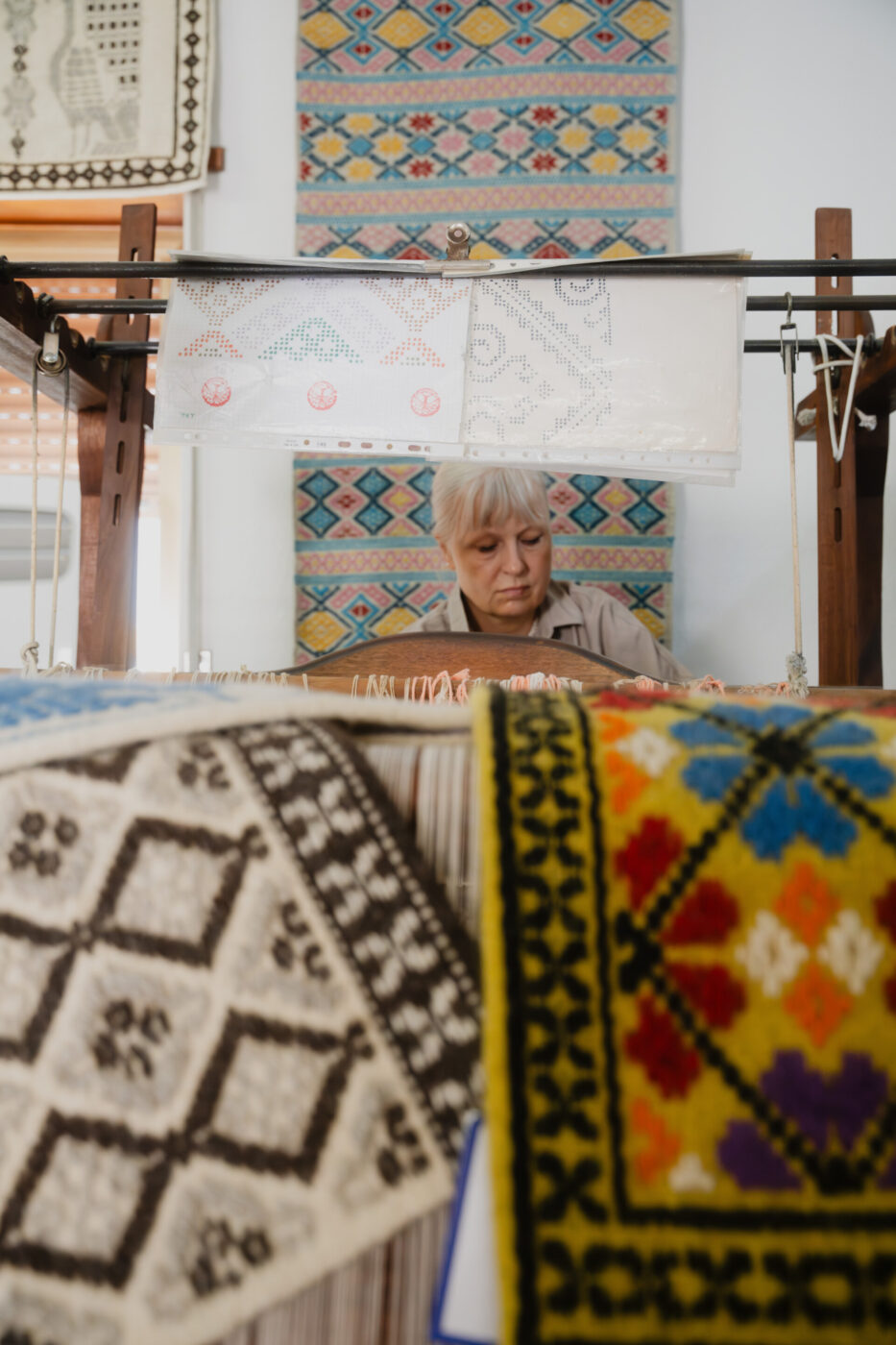
Hairpin roads climb toward Nule, a small inland town where the same palette reappears—this time in wool. Like a handful of Sardinia’s interior villages, Nule is a historic center of hand-weaving. Here, sheep’s wool is dyed in seven traditional colors—yellow, blue, black, brown, white, red, and green—then worked into dense carpets that are identical front and back. Their surfaces are marked with ancient motifs: zigzags known as pelle di pesce (fish skin), white dotted rows called dentini (little teeth), and rhombuses framing the fiamma, a central flame symbolizing the cycle of life, death, and renewal.
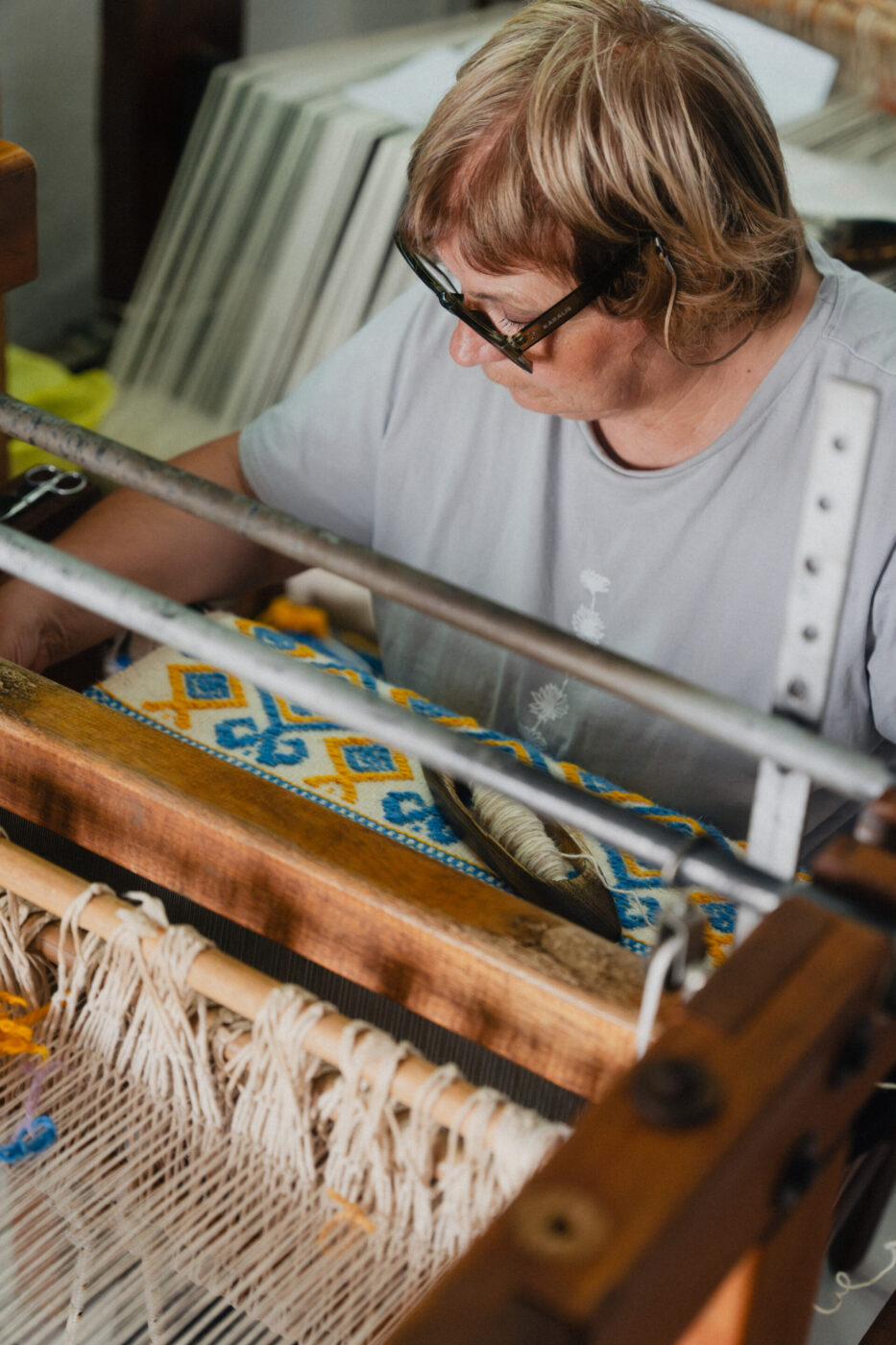
In the kitchens and spare rooms where a few elderly craftswomen still weave at home, Sardinia’s craft tradition, and the pastoral livelihood linked with it, is more ember than flame. Giovanna Chessa and Giovanna Maria Campus are two of the last generation of weavers to remember a time when most women in the town wove as their livelihood. “Around the time that I was getting married, women were already beginning to stop learning and practicing weaving. Their husbands could now afford to support the family, and there were other jobs that they could do,” recalls Giovanna Chessa. “I continued because I believe this work gratifies people.”
Historically, handweaving was a domestic craft passed down from mother to daughter; in Giovanna’s day, girls across the island could attend weaving schools to master the craft, along with the adjacent arts of spinning yarn from wool and natural dyeing. The towering vertical looms unique to the mountainous Barbagia region, specifically Nule and Sarule, require specialized training and are so big that two women must work side-by-side on a single loom, employing an ancient, bottom-up technique prized for its geometric precision.
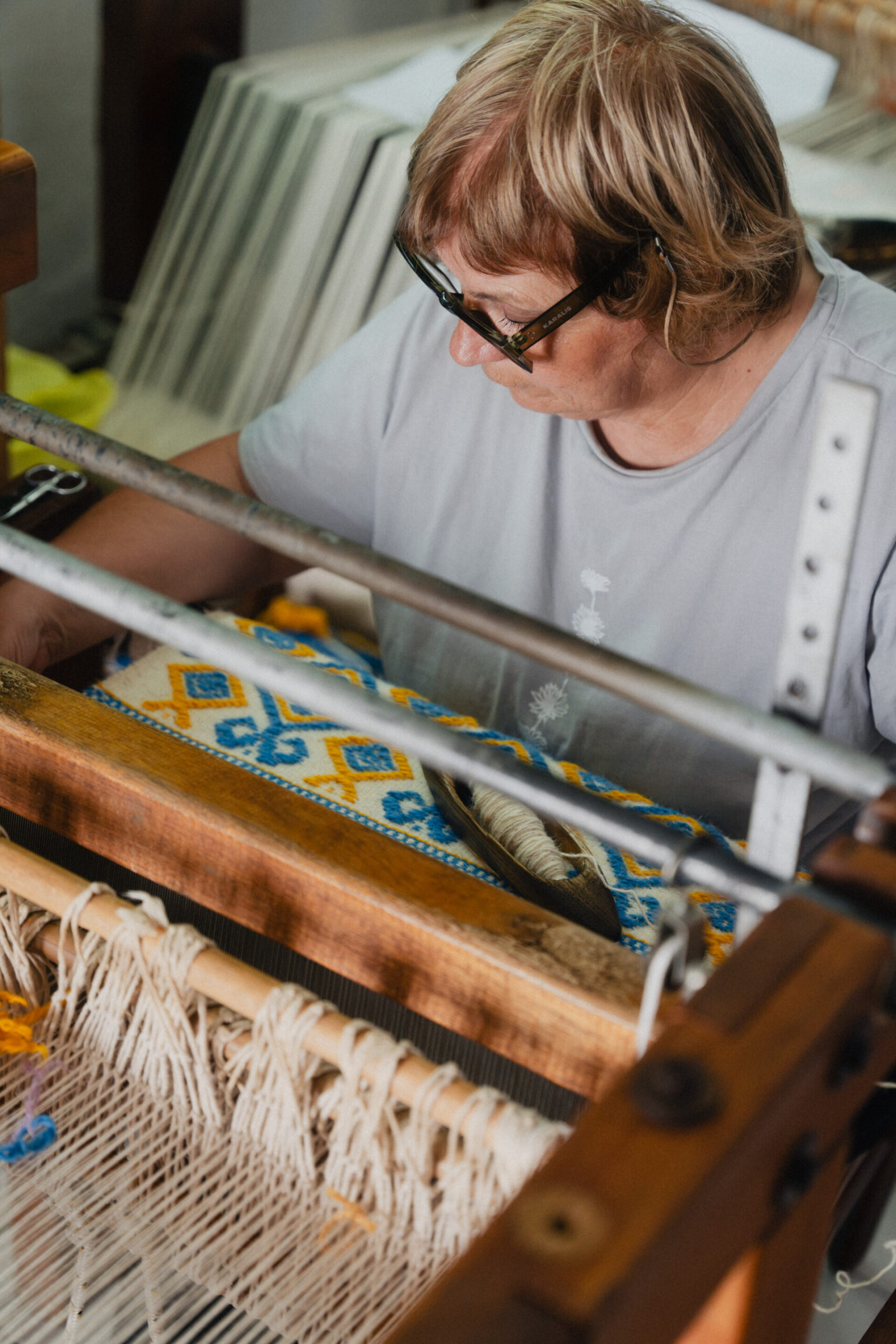
While Nule and Sarule are defined by these heavy wools and vertical looms, the textile map changes as you descend into the island’s plains and coastal valleys. Here, horizontal looms, which allow for faster production, have long been the domestic standard for everyday linens and cottons. Every region developed its own specialized type of weaving: Mogoro became celebrated for its embroidered wall hangings; Orgosolo for its silk headdresses; and along the southern coastline, a rare few still make accessories with sea silk, spun from the fibers of marine bivalves.
The women of pastoral communities across Sardinia’s rural hinterland historically made textiles for practical survival, most often in the form of bisacce—rectangular shawls with a deep pocket on each end. Shepherds and donkeys wore simple versions to carry tools and grain across the land, and the harvest itself was dried on functional rugs these women also wove. For special occasions, this utility gave way to artistry, featuring ornamental bisacce, colorful bolero jackets, and pleated skirts, along with intricate tapestries hung from windows across town.
But perhaps the most curious element of Sardinia’s textile tradition is the tapinu ‘e mortu: funeral cloths upon which bodies were laid, most often used during the elite wakes of 18th- and 19th-century Orgosolo. Only 12 are known to exist today, five of which are preserved at the Museo Unico Regionale dell’Arte Tessile Sarda (MURATS) in Samugheo. “Skilled in textile art since ancient times, women used to produce more than their families needed, as they actively traded their own works,” the museum’s curators write. “This was the decisive factor that made Samugheo famous beyond Sardinian borders.”
The museum’s archive contains many pieces from the mid-20th century, when the island’s crafts faced extinction, thanks to the Sardinian Institute for the Organization of Crafts (ISOLA); in the 1950s, the institute successfully documented and preserved the island’s weaving methods, along with other crafts, using illustrative books, interviews, and photographs. At MURATS, a small, brilliant team of cultural professionals, many of whom are weavers themselves, regularly facilitates exhibitions, residencies, and collaborations, so new generations can learn traditional techniques while adapting them to contemporary life.
But the museum is not the only place where the island’s tradition is preserved. Just minutes away, weaver Isabella Frongia works alongside a small team of women—including her mother Susanna, now in her 90s—to run a weaving studio committed to 100% handmade production. These weavers say that communal artistry outranks rapid production, although the blur of their hands while stringing together pibiones (raised, twirled stitches that borrow the Sardinian word for grape) is certainly something to behold. “Unfortunately, commercial textiles—mass-produced in computerized factories and… using electric powerlooms—compete with weavings made completely by hand. [They] reproduce traditional designs and simulate weaving techniques used by handweavers, yet the commercial textiles are produced in bulk, created in minutes rather than days, and sold at a low cost—misleadingly marketed as ‘authentic, handwoven textiles,’” Isabella told Sardinian Arts. “However, those with a trained eye can discern a truly authentic handwoven textile, noting the quality, care, and attention to detail the handweaver infused into the textile.”
“Having been raised in the culture of handweavers, my dream when I was young was to do something different: study at the conservatory, become a pianist, and take up a musical career,” she said. “Yet now I am proud that I continue to carry forward the art of handweaving, preserving the authenticity of this art and the skills I acquired from my mother, Susanna.”
Makers like Isabella, who have successfully commercialized their crafts without losing the artisanal nature of their production, are the few torchbearers carrying Sardinian carpet weaving into a new era. They are joined by enduring institutions like Su Trobasciu, a women’s weaving cooperative founded in Mogoro under ISOLA that’s still active today, reworking traditional forms with updated colors and sensibilities.
Contemporary studios like Mariatonia Urru continue this dialogue between past and present, combining traditional patterns with sustainable practices and modern materials. Beyond the island, Sardinian weaving has also captured international attention—most visibly in Dolce&Gabbana’s 2024 Alta Moda collection, which collaborated directly with local artisans and celebrated the island’s craftsmanship on a global stage.
Purists might argue that such reinterpretations stray too far from tradition. But tradition, in Sardinia as anywhere else, has never been static. Thanks to those who have safeguarded its knowledge, Sardinian weaving is following the same philosophy echoed in its symbolism: creation, death, new life.
WHERE TO COLLECT ARTISANAL TEXTILES IN SARDINIA
Giovanna Maria Campus (Nule) – A leading figure in Sardinian textile art, Campus is known for her refined handwoven tapestries that reinterpret traditional motifs. Her work is deeply rooted in local wool traditions.
Giovanna Chessa (Nule) – At her workshop, Chessa continues the textile heritage of Nule with rugs, wall hangings, and decorative textiles made on traditional looms. Expect bold patterns. Message through Facebook for details.
Isabella Frongia Handweaving Studio (Samugheo) – Frongia’s studio is dedicated to preserving and evolving Sardinia’s weaving traditions through the meticulous craftsmanship that she learned from her mom at the age of 10.
Su Trobasciu Weaver’s Cooperative (Mogoro) – This historic cooperative brings together local artisans specializing in handwoven rugs, tapestries, and home textiles made on vertical looms. Each piece reflects Mogoro’s long-standing weaving culture, with an emphasis on natural materials (wool, cotton, linen) and traditional patterns.
WHERE TO LEARN ABOUT SARDINIA’S TEXTILE TRADITIONS
Museo Unico Regionale dell’Arte Tessile Sarda (Samugheo) – Sardinia’s most important textile museum, offering a deep dive into the island’s weaving traditions through historic looms, ceremonial fabrics, and contemporary works.
Saperi e Sapori – Tastes and Textiles Tours (Various towns) – These tours are a guided way to meet Sardinia’s carpet weavers firsthand, combining studio visits with cultural storytelling, hands-on experience, and local food. They book a year in advance.