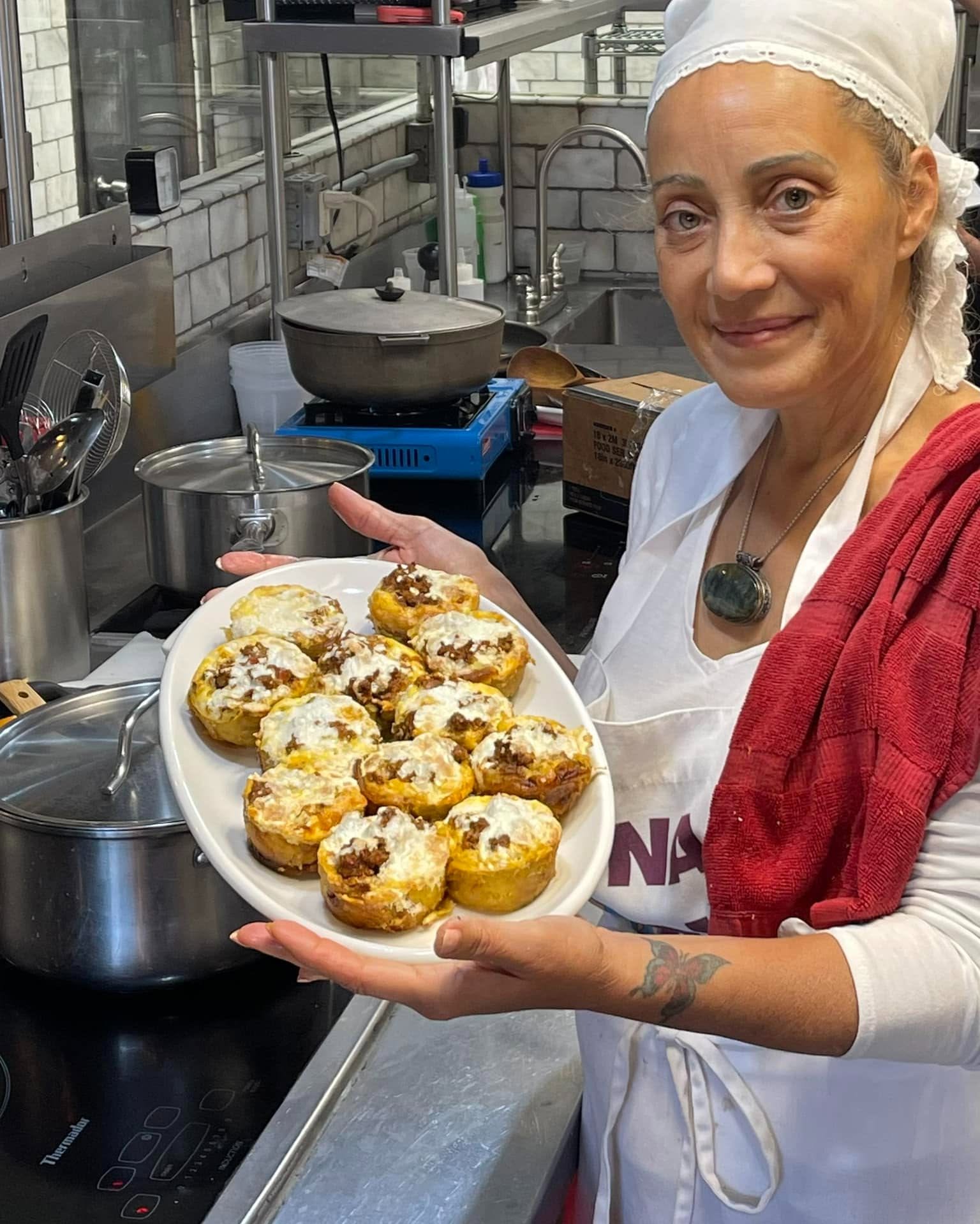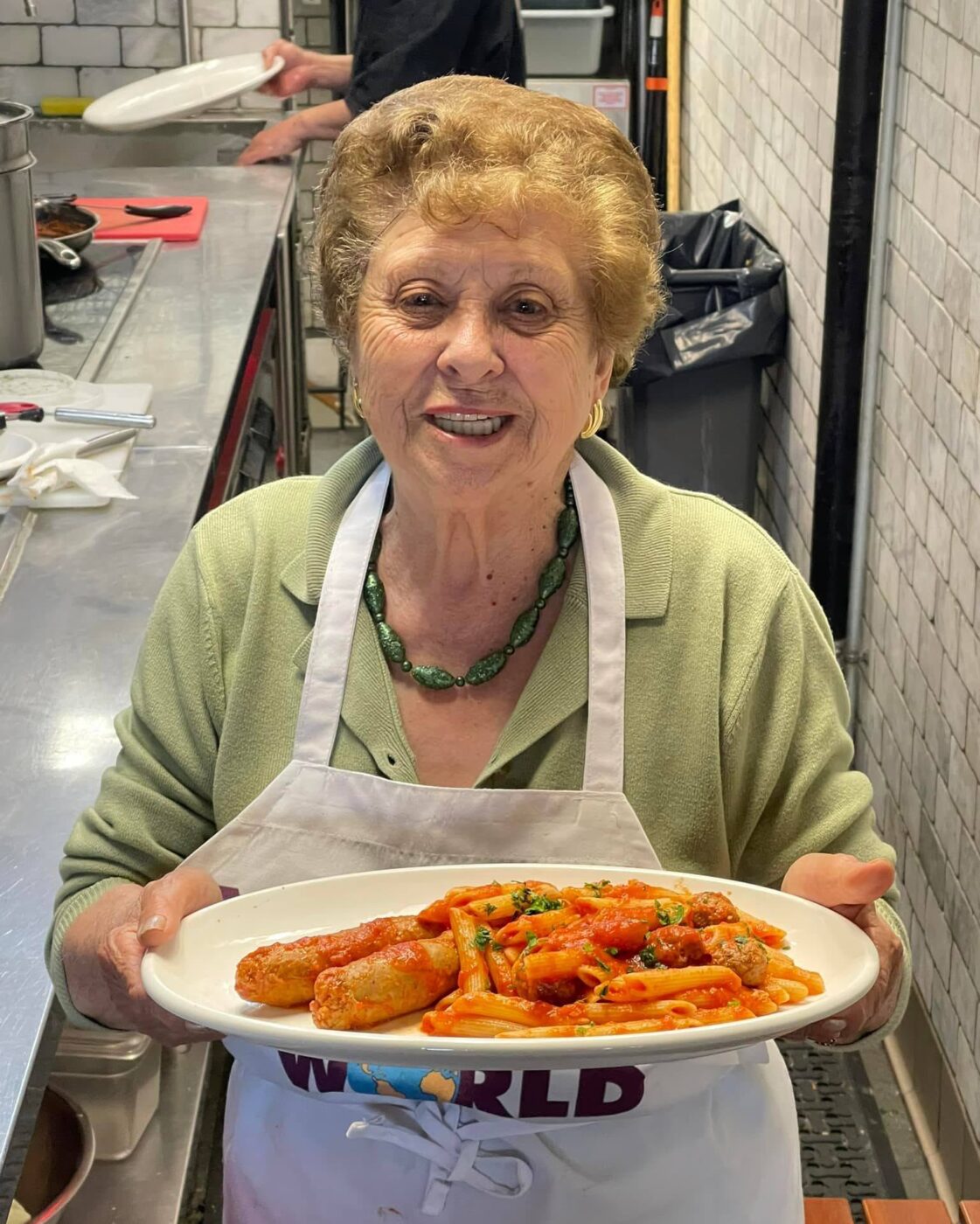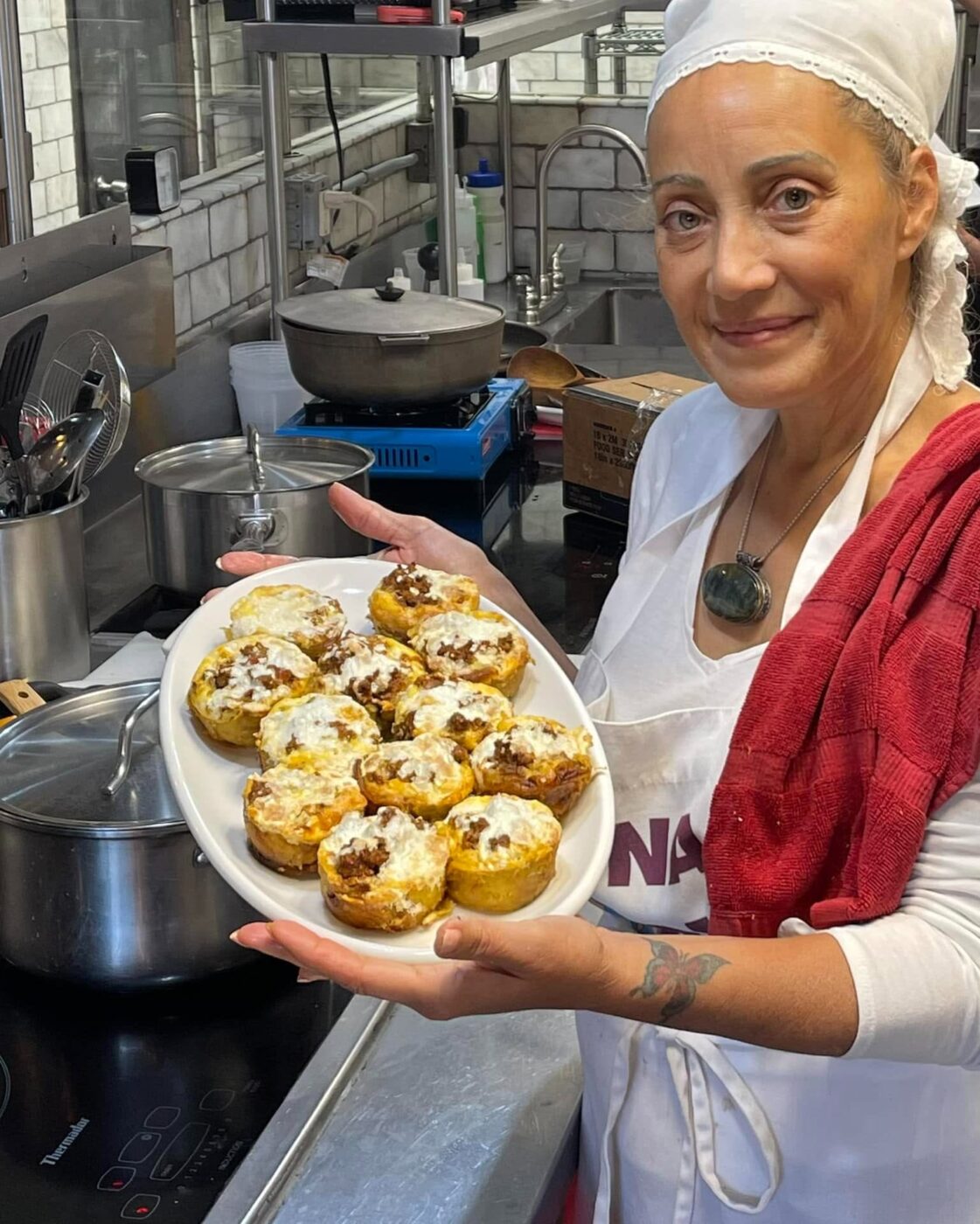
Nonna May Joseph (71) squeezes me tightly and urges me to eat up. May Joseph is not my real nonna. But the way she hugs me, fusses over my plate, and insists I take another bite feels exactly like something a grandmother would do. She’s one of the rotating grandmothers who cook at Enoteca Maria – a tiny, hole-in-the-wall, 35-seat restaurant tucked away on New York’s Staten Island. There’s only one requirement to become a chef here: you must be over 50 years old – and you must cook the way you learned at home.
Getting there is part of the experience. A ferry from Manhattan glides past the Statue of Liberty before depositing you somewhere slower, quieter, a New York most visitors never see. Inside the Enoteca the walls are covered with memorabilia and family photographs, it smells of garlic and simmering tomato sauce: a sense of belonging before you even sit down. It’s like stepping into a grandmother’s house: warm, chaotic, comforting. Online booking? Forget it. Credit cards? Forget those too. In true nonna fashion, reservations are made the old-school way: by picking up the phone. (+1 (718) 447-2777)
Enoteca Maria is the brainchild of 69-year-old Italian-American Joe Scaravella. A former transportation worker who, after losing his grandmother, his mother Maria – the inspiration behind the Enoteca’s name – and then his sister in quick succession nearly two decades ago, found himself overwhelmed by immense grief. With the small sum of money he inherited, he bought a locale on Staten Island, spending nearly everything he had building it out. “That wasn’t very smart,” he admits, laughing.
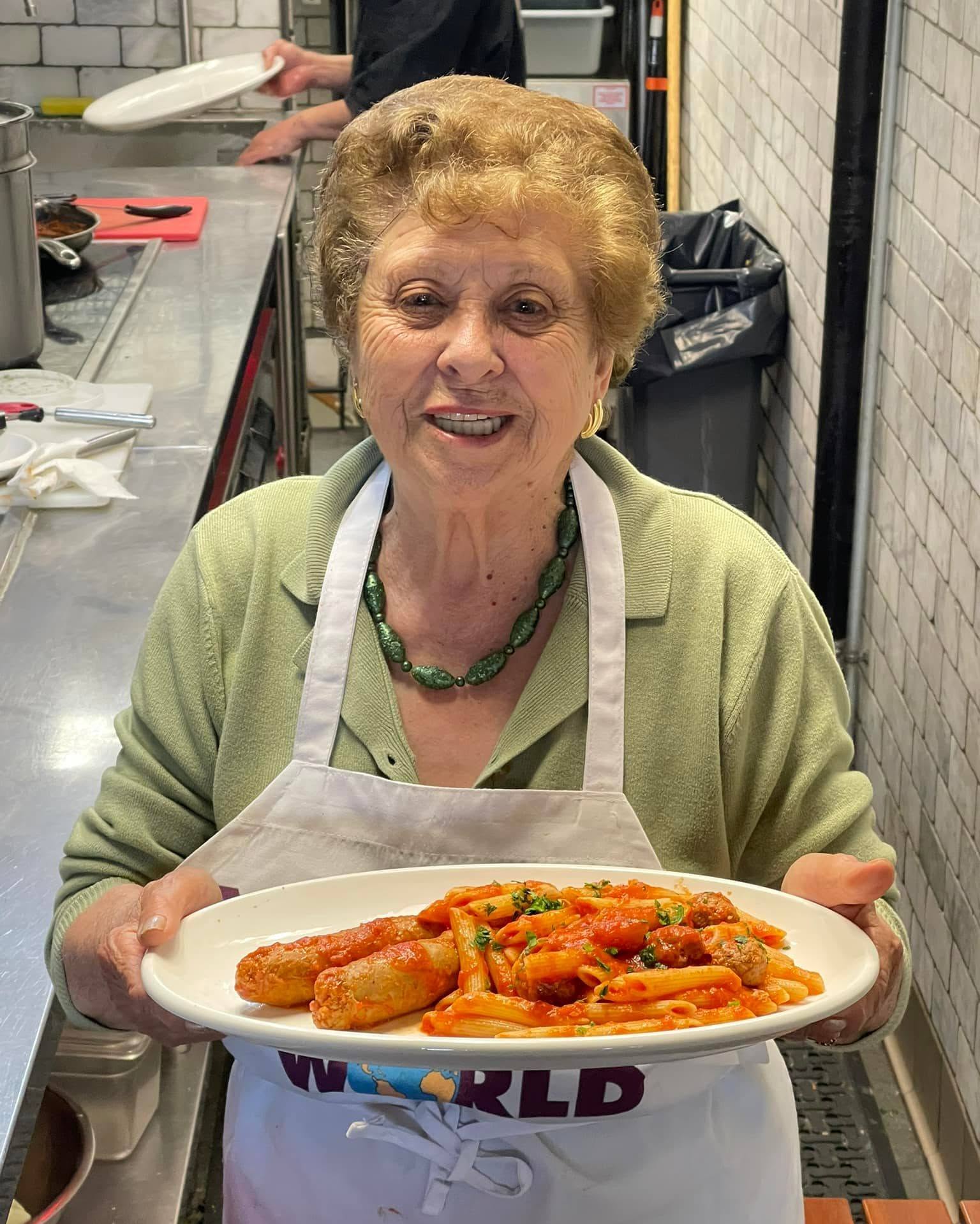
Scaravella placed an ad in an Italian-American newspaper that read: “Cercasi casalinga” – “looking for housewives.” Grandmothers arrived in droves, often dragging husbands, children, and grandchildren behind them. Each wanted Joe to taste her signature dish. Joe hired some of them, only to quickly realize he’d made a mistake. Two nonnas in one kitchen, it turns out, is one too many. So Scaravella came up with a new system: the grandmothers cook one at a time. Each nonna takes over the kitchen for the day, creating a small menu based entirely on the dishes she grew up cooking at home.
Courtesy of Enoteca Maria
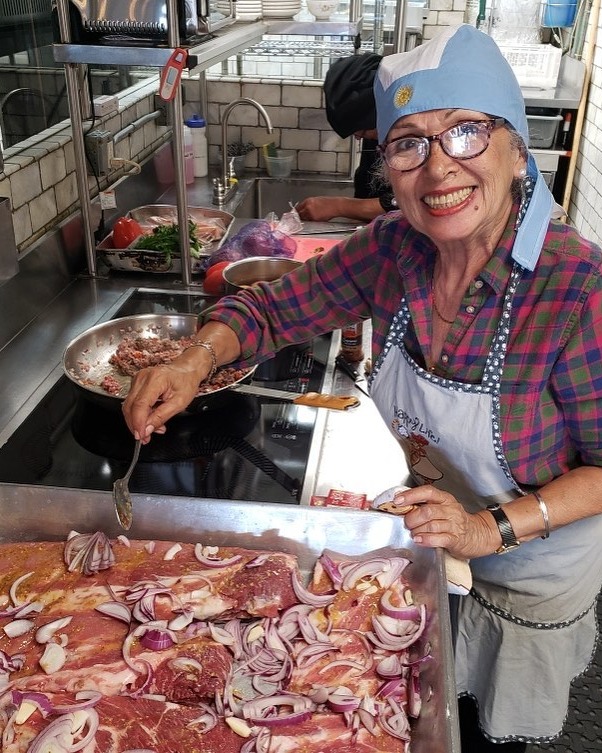
Today, Enoteca Maria employs around 40 grandmas – or “ladies,” as he likes to call them – the oldest of whom is 91. And while it began as a celebration of Italian cooking, it has since expanded far beyond that: After a decade, Joe began welcoming grandmothers from around the world – women from Argentina, Sri Lanka, China, Mexico, and beyond. “The Italian ladies,” he adds, with affectionate amusement, “are still the loudest.”
At the end of the day, “It’s not really about the food,” Joe tells me. “It’s about the ladies passing information on to the next generation. It’s about the nurturing aspect. It’s about going to the source. Most restaurants you go into – they do a good job – but it’s not from the heart.”
Before I can leave, Joe insists I must come back to cook with his nonnas. There is absolutely no way I’m saying no. A few days later, I find myself back in the kitchen – not the stressful, fast-paced and noisy kitchens most restaurants run on, but one with the warmth of a living room. Instead of sharp commands, the ladies, white-haired, softly wrinkled, with wisdom in their eyes, address one another with a gentleness as “darling,” “love,” and “sweetheart.”
For three hours straight, I slice vegetables into impossibly thin strips while Nonna May Joseph stands beside me, her hands cramping too much to do it herself. Between corrections – “no, thinner, thinner” – she tells me her entire life story. Today she is teaching me how to make a Sri Lankan curry, a dish layered with turmeric, ginger, garlic, and coconut milk. As the vegetables hit the pan, the kitchen fills with the warm fragrance of spices – a scent that feels worlds away from Staten Island.
May Joseph emigrated to New York from Sri Lanka several decades ago. “Cooking,” she tells me, “was how I kept a piece of home alive.” Her resilience is unmistakable: she has survived breast cancer and built a life far from the place where she grew up. She doesn’t have grandchildren of her own, but she tells me lovingly about her niece, her voice softening every time she mentions her.
Courtesy of Enoteca Maria
Joe has poured every penny he owns into the restaurant over the past two decades. He hasn’t paid himself once during all that time. “Every day we should try to make ourselves better than the day before,” he says. “If you don’t, you’ve wasted your life.” Now he plans to turn Enoteca Maria into a not-for-profit, expanding the program to teach children how to cook. He envisions a cross-generational exchange, where kitchens become classrooms and the nonnas become teachers, passing down their wisdom to the next generation.
That longing for the familiarity of a grandma’s home has struck a chord far beyond Staten Island. Enoteca Maria surged into the mainstream after Netflix released Nonnas, a film inspired by Joe’s story and starring Vince Vaughn as Joe. The movie racked up over 15 million views in its first week alone. And yes – just like in the film – I can confirm they really do serve capuzzelle: a traditional southern Italian dish made from a slow-braised sheep’s head.
“There’s going to be a sequel,” Joe says proudly. Nonnas of the World. This time, we’re moving beyond Italian grandmothers.” “I get bored really fast,” he adds with a grin, “that’s why I like to keep it moving. Vince Vaughn doesn’t usually do sequels, but he wants to be part of this one!” Laying out his life and personal stories to such a vast public is difficult for Joe. But he insists it’s worth it. “Sometimes people come into the restaurant, want to take a picture with me, and start crying,” he says quietly.
“We’re working on a virtual book,” Joe tells me. “It’s called Nonnas of the World. It’s free, and anyone can submit their mother’s or grandmother’s recipes. The world doesn’t need another cookbook, there’s millions of cookbooks. What this is, is a living book, always expanding. Open to contributions from everyone to preserve their mothers’ and grandmothers’ cooking in history.”
When I leave, May Joseph makes me promise to visit her at home where she wants to cook for me. She isn’t my nonna. But for a few hours, she absolutely felt like one. In a vibrant and hectic metropolis like New York, where one can feel lost and lonely so easily, a place like Enoteca Maria makes you feel seen, connected, and wonderfully at home.