It was one of those classic spring days in Cilento. The weather was erratic, with half an hour of scorching sunshine followed by torrential rain. The clouds had gathered on top of the ridge of hills, before creeping down into the expanse of farmland and rolling swiftly across the patchwork of green fields towards the sea.
“Degustazione prodotti tipici, pizza con mozzarella di bufala,” the faded and somewhat overgrown sign on the roadside informed us. “Mozzarella di Bufala Campana,” read another. “Benvenuti a Paestum,” was written on a third.
I was in Campania to try mozzarella. Specifically, buffalo-milk mozzarella. Specifically, in the town of Paestum. You can buy mozzarella all over the world, from the refrigerator aisle of corner shops in dingy London suburbs to the bustling delis of Little Italy in New York. It’s produced in the USA, Australia, and even South Africa. But if you want to taste the real thing, the Protected Designation of Origin (DOP) product, Campania is the place to do it.
“The farm was bought by my great grandfather at the start of the 20th century,” Teresa Palmieri explains to me. The farm in question, Tenuta Vannulo, is owned by the Palmieri family and is now in its third generation of farmers. What began as a fruit, vegetable, and livestock farm was transformed into a caseificio (dairy) in the late 1980s by Teresa’s father. He saw an on-site dairy with mozzarella production facilities as a business opportunity. Forty years later, Teresa and her two siblings are continuing the family tradition.
The trio of siblings grew up in the fields, running amongst the buffalo. “My first memory, from when I was three years old, was the day my sister was born,” Teresa tells me. “Before going to the hospital, I went with dad to check on the buffaloes, to see if they were okay.” As children, the farm was their playground—they helped milk the buffaloes, petted them, tasted the cheese. At 10 years old, Teresa even helped out behind the till in the shop.
“The thing with mozzarella is that it must be sold on the same day [it’s made],” Teresa explains. She and the team are up every day at 4 AM, making cheese. It’s then sold to customers from 9 AM that same morning. The buffalos “decide when they want to be milked,” thanks to automated milking machines. The milk is collected twice a day, once in the morning and then again in the evening. One buffalo can produce eight liters of milk daily, she tells me, and you need four liters of milk to make one cheese.
The whole process, from milking to the moment that the orb-like mozzarellas are ready to be eaten, takes five to six hours with a staff of five. It may sound like a fairly long and labor-intensive process for a relatively small ball of cheese, but Teresa is keen to stress that the farm would rather have “quality over quantity.” They have around 450 buffalo which produce milk. All of the mozzarella produced on the farm is made using traditional techniques and by hand. Everything is certified organic.
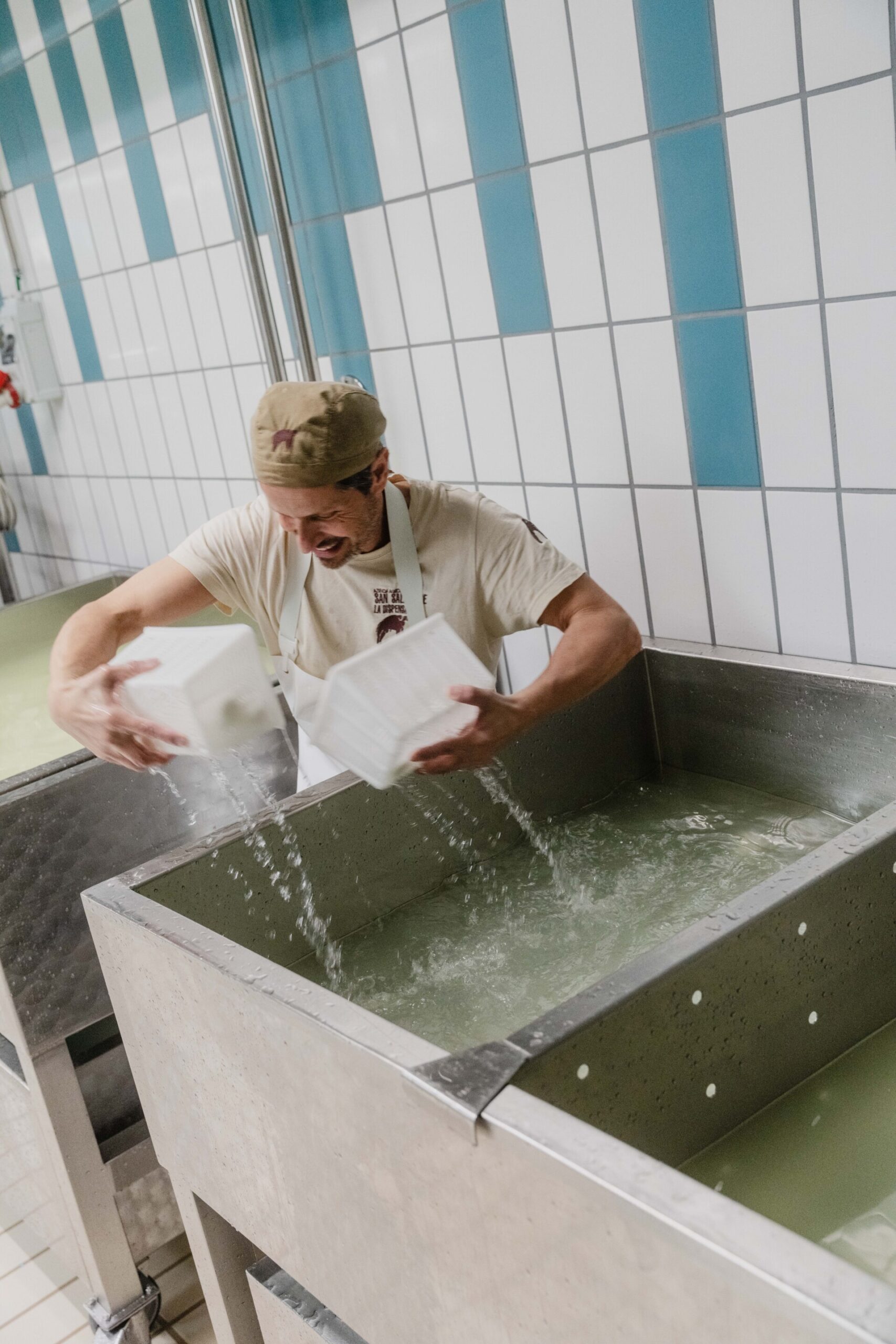
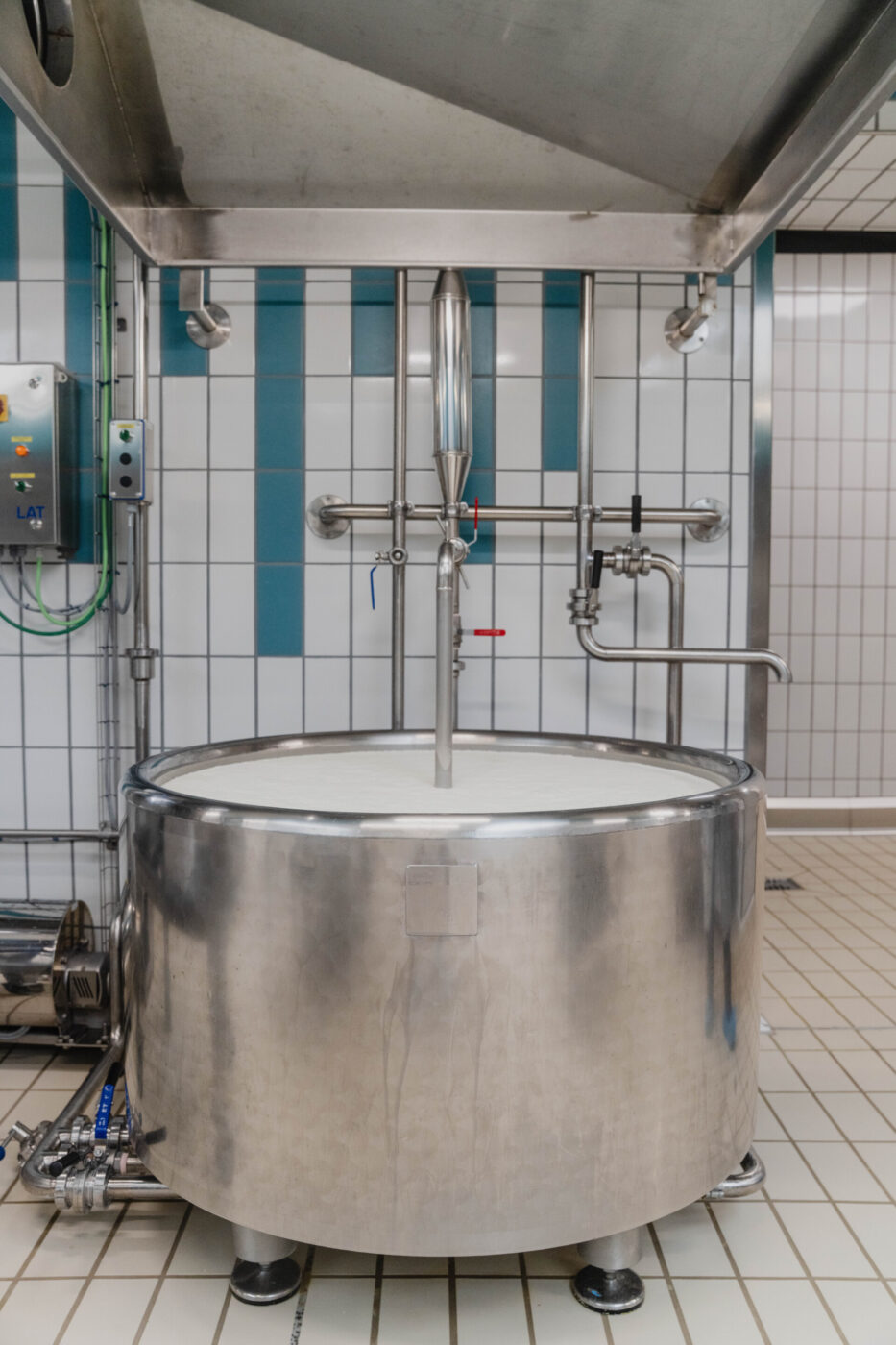
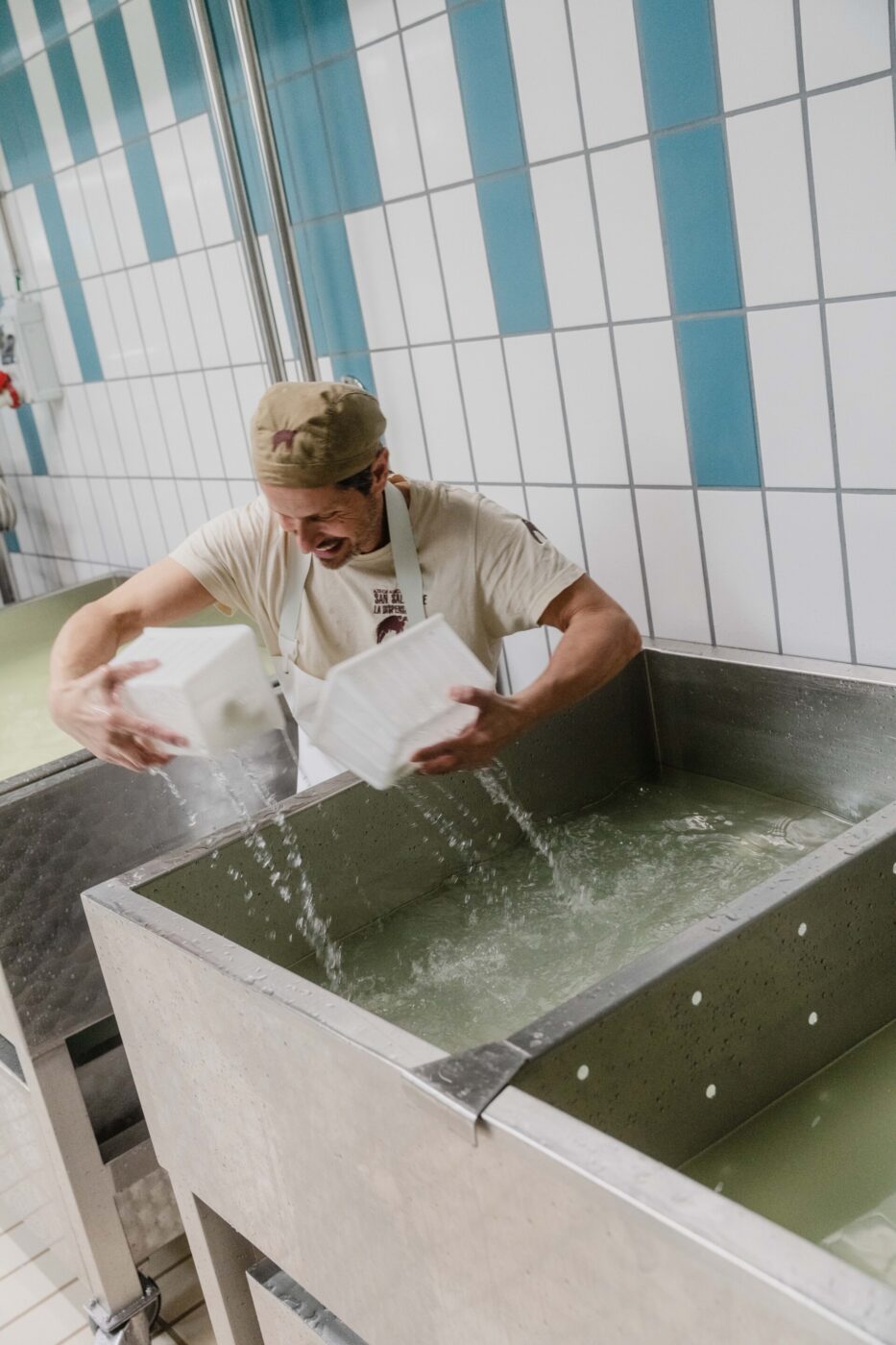
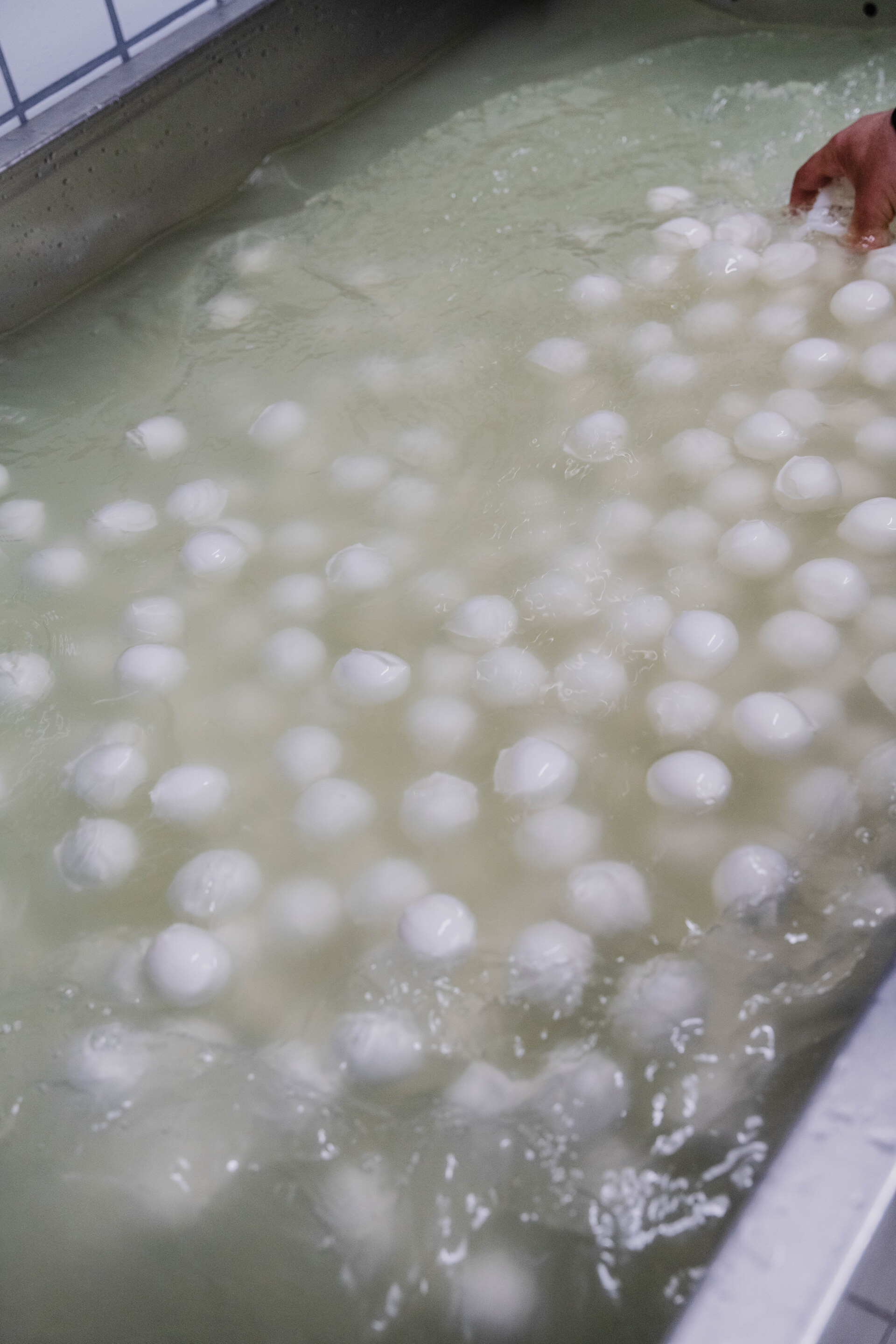
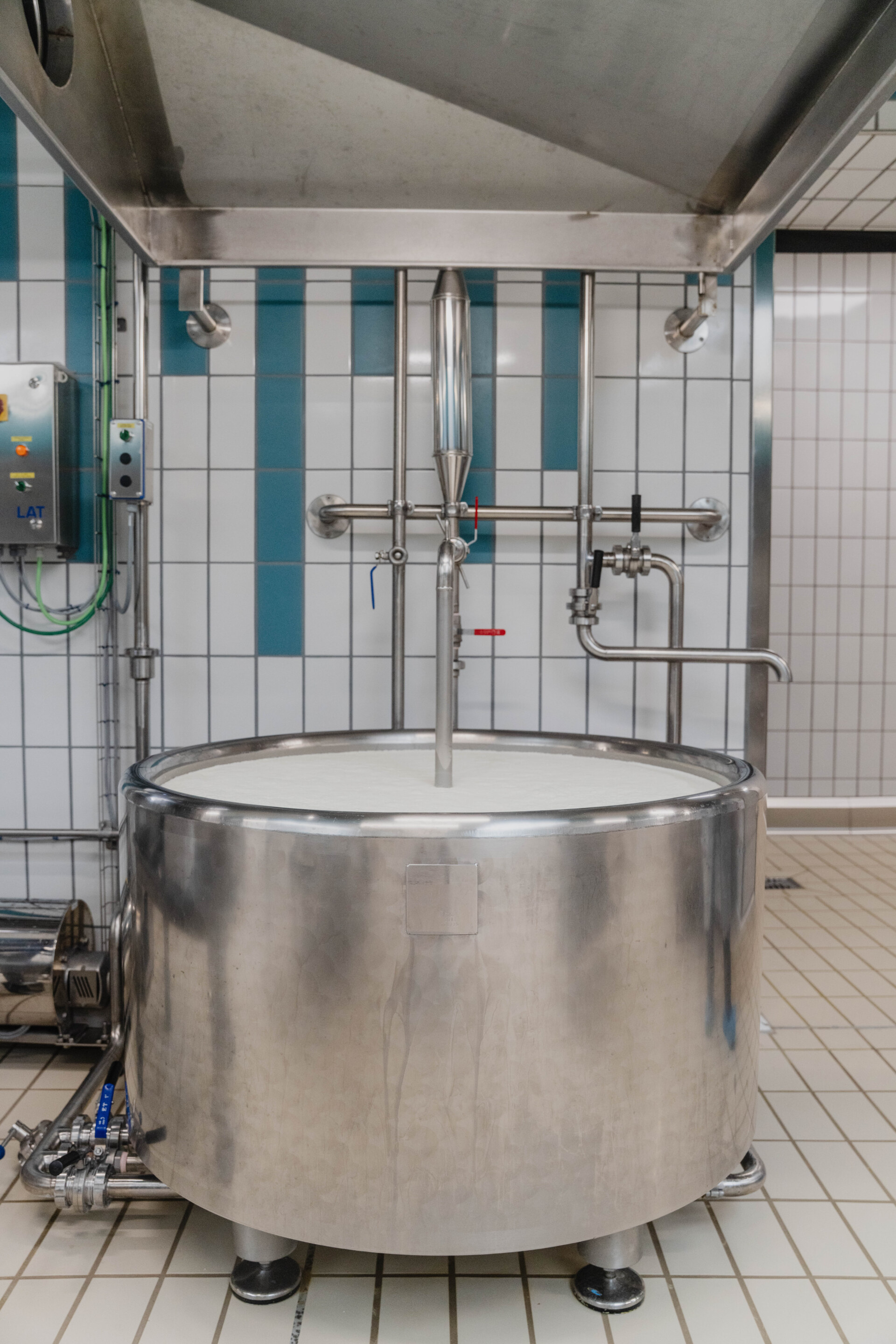
Once the cows have been milked, the raw milk travels along an underground pipe from the milking barn, to the dairy. Upon arrival, it is filtered and curdled by heating it to 37°C and adding rennet. Then it’s left to “ripen” in huge vats, where it coagulates and the curd forms. “It’s a slow process,” says Teresa, and lasts about four hours in total, during which there are two breaks to allow the whey to drain. When the curd is ready to be stretched, it’s removed from the whey, placed on tables, chopped into blocks of about 10 kg each, and added to a vat with boiling water.
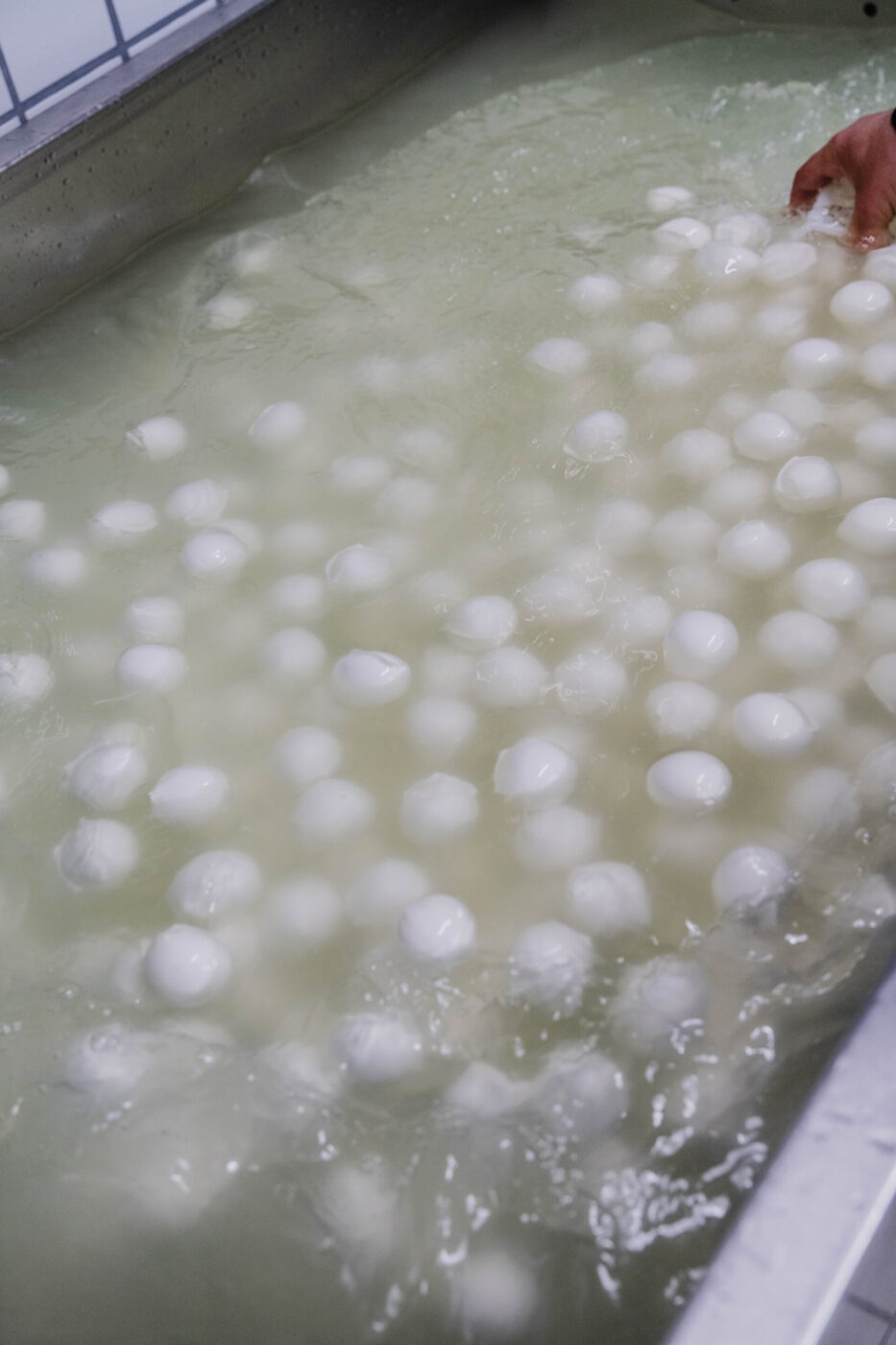
It’s at this point that the famous mozzatura stage begins: two people squeeze and stretch the cheese by hand between their thumb and forefinger to separate it into mozzarella-sized pieces. This is where the name mozzarella comes from: mozzare, means “to cut off”—in this instance, by hand. The whole thing is mesmerizing to watch. Balls of all sizes are produced, from a standard 125g ball and golf-ball-sized ones, known as bocconcini (around 50g), to tiny cherry-sized ciliegine (named after the fruit). The beauty of the bocconcini—literally “little mouths” in Italian—is that they fit perfectly into your mouth. You should eat it in one bite, or so I’m told… There’s definitely an art to it.
“Many many years ago, these lands used to be a swamp, so it’s very verdant,” says Teresa. As you gaze out across the plains, dotted with chocolate brown buffalo, flicking their tails at unsuspecting flies, it’s strange to think that there have been buffalo grazing on the land for over 1,000 years. No one really knows just how the animal made it to Italy. They’re native to India and Southeast Asia, and it’s thought that they were brought to Campania by the Normans, from Sicily, where they were supposedly introduced by the Moors. During World War II, many of Italy’s buffalo herds were slaughtered by occupying German forces in an attempt to damage local agriculture and destroy local food sources. After, in the 1940s and ’50s, water buffalo were imported back onto the peninsula from India.
On the other side of Paestum, I’m greeted by the low murmur of buffalo feeding contentedly on fresh hay when I arrive at Caseificio Barlotti. Much like Tenuta Vannulo, this farm sells a variety of buffalo-milk based products—beyond the obvious mozzarella and ricotta, yogurt, milk, and chocolate spread. Even cappuccinos made and served, on site, with buffalo milk.
“Why use buffalo milk for mozzarella rather than cow’s milk?” I ask Andrea, who I meet in the shop. “It’s much richer than cow’s milk and full of vitamins and fat, not like fior de latte which is just like latex for cooking,” he tells me.
The mozzarella almost has a skin to it—sharp until it bursts to reveal a creamy, mellow interior, perfect with sweet, local tomatoes and olive oil. The ricotta brings meadowy aromas. The milk is dense and creamy, so dense and creamy that, frothed into a cappuccino, it’s almost too much.
At Tenuta Vannulo, they intend to one day produce buffalo-milk chocolate and even sell buffalo meat. “It’s an excellent meat, rich in iron. We want to focus on a product that is currently very undervalued by the market,” Teresa explains. There are even plans for ready-made ragùs using buffalo instead of beef, to try and tap into that market. “[Ready-made] is even catching on in the countryside nowadays,” she tells me. I suppose, these days, even traditional buffalo mozzarella farms must keep up with trends.
As the sweet scent of olive blossoms wafts through the air, the buffalo low contentedly, and the sun gently caresses my skin, it’s easy to understand the enthusiasm with which Teresa and her siblings have taken over their parents’ farm. It’s more than easy to understand why they wanted to stay in lovely Cilento.