We’re surrounded by it. In magazines, on the radio, on TV, on city walls, along motorway billboards, on our phones, inside apps, across websites, whispering into our headphones. Advertising is everywhere and it controls our lives. It’s often described as the soul of commerce: a technique that makes us desire things we don’t need, a kind of spell that convinces us to buy products we already own, a divertissement that hides far more than it seems to reveal.
Long loved and just as long resented, advertising in Italy quickly became more than a commercial tool. From the very beginning, it took on the qualities of a genuine artistic expression. A playground for human creativity where—if we’re allowed a cliché—Italians do it better. Campaigns, images and authors that have, over time, become cultural icons in their own right.
From late-19th-century posters to Futurism, from the radio propaganda of the Fascist era to the television Carosello of the economic boom, and on to the bold experiments of the 1970s and ’80s, Italian advertising has chronicled the country’s social, economic and cultural history since its earliest days. A mirror held up to a nation in constant flux, forever balancing deep-rooted tradition with sudden, irrepressible bursts of rebellion.
The very beginning
It was the pharmacist Attilio Manzoni, from Brescia, who founded A. Manzoni & Co. in 1863—the first advertising agency in Italy. He quickly grasped the power of newspaper space as a tool for promoting not only his own products, but those of other pharmaceutical companies as well. As printing techniques became faster, cheaper and more flexible, réclame—as advertising was known at the time—spread rapidly toward the end of the 19th century, moving beyond newspaper pages and into the urban landscape, with the first posters appearing on city walls.
So popular, in fact, that the Italian Parliament introduced a tax on billboards (surprise, surprise), a clear sign of just how deeply advertising had embedded itself in everyday city life.
It was in this context that, as in France and England, Italy too saw the rise—between the late 19th and early 20th centuries—of the artist-designed poster. Major brands competed to commission illustrators capable of quite literally bringing products to life, turning commercial communication into a space for bold visual and aesthetic experimentation.
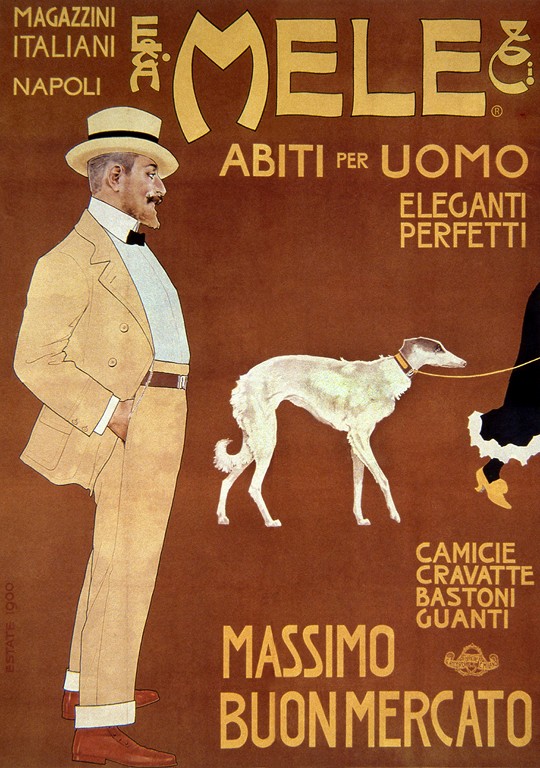
Commercial for Grandi Magazzini Mele; Archivi della moda del Novecento
Roaring Twenties
At the beginning of the 20th century, Italian advertising sheds its old skin. It’s no longer just about being recognised, but about celebrating a product’s quality, personality and promise. This is when the word pubblicità finally replaces the more French réclame, marking a coming of age in both language and ambition.
The modern testimonial is born too. Famous faces and big names begin lending their aura to products: composer Giacomo Puccini (yes, that Puccini) happily pens verses for a toothpaste ad, while Gabriele D’Annunzio—the undisputed master of self-promotion—writes slogans and lends his image to Amaro Montenegro and Saiwa biscuits, blending consumption, literature and personal myth into one spectacular gesture. A true early influencer.
At the same time, the shockwave of Futurism brings a visual jolt like no other. Artists such as Filippo Tommaso Marinetti and Fortunato Depero turn advertising into an avant-garde playground, where brands like Campari become laboratories for bold graphic, typographic and chromatic experimentation. Commercial communication becomes art, movement, provocation.
After World War I—when advertising techniques had already been widely deployed for military propaganda—the first modern Italian agency, ACME-Dal Monte, is founded in 1922. A few years later comes another revolution: radio. In 1927, Italy’s first musical commercial airs, promoting Salitina mineral water. It marks the beginning of the age of jingles, catchy slogans and earworms that, entering people’s homes, would forever change the way products—and perhaps even the country itself—were told and sold.
The censorship of Fascism
As usual, dictatorships ruin everything. Advertising included. Under Fascism, censorship and top-down control leave little room for commercial creativity. Autarchic policies, economic hardship and the regime’s obsessive supervision drastically shrink the space for advertising, much of which is swallowed up by the blunt, heavy-handed language of Fascist propaganda.
The public sphere is flooded with ideological imagery: propaganda posters, belligerent slogans and totalitarian symbols take over city walls. Eagles, fasces, references to Ancient Rome and fantasies of national greatness replace product promotion, bent to a monumental, rhetorical aesthetic designed to persuade rather than entice.
Even everyday imagery is rewritten. The independent woman—so common in early 20th-century posters, confidently sitting at a bar with an amaro—is erased. In her place appear women confined to domestic spaces, carefully framed as wives and Christian mothers, obedient and contained.
Carosello!
In the post-war years, with the arrival of television, advertising became a mirror of a society in fast-forward. On February 3, 1957, RAI aired Carosello and—without realising it—changed Italians’ relationship with advertising forever. For twenty years, it wasn’t just a TV programme but a nightly ritual: a fixed appointment, the unofficial signal that “after this, it’s bedtime.”
To avoid overwhelming viewers, advertising was carefully contained within Carosello and reduced to the bare minimum: just 5% of total airtime. But what a 5%! Each ad was a miniature theatrical performance: 105 seconds of storytelling—comic sketches, animation, short films—followed by a 30-second ending in which, only at the very end, the product could finally be mentioned.
Carosello gave birth to characters that slipped straight into collective memory: Calimero, the misunderstood little chick; Lavazza’s moustached man; La Linea for Lagostina (personal fav); Topo Gigio.
And slogans that still resurface, unannounced, in the most unlikely conversations. Advertising became gentle, reassuring, almost familial, with famous actors and singers stepping into Italian living rooms—Mina, for instance, who for years was the face of Barilla. Among the short movies made for the Carosello I would love to highlight a couple – one very Italian, with Paolo Villaggio, a Genoese comedian with a unique and bittersweet sense of humour and the gorgeously designed carosello by Vittorio Carpignano.
And yet, beneath all that sweetness lies a small paradox. Many industry insiders argue that Carosello ultimately slowed the evolution of Italian advertising. Locked into a rigid narrative format, creatives and brands remained distant from the short, punchy spot model that was taking hold elsewhere—especially in the United States, long the lighthouse Italian advertisers watched with a mix of fascination and envy.
The political 70s
As with all artistic forms, the 1970s marked an ideological turning point for advertising, too. After Italy had said goodbye to its agricultural DNA in the 1960s—embracing industrialisation and full-throttle capitalism—the 1973 oil crisis shattered faith in the idea of endless economic growth. The heavy political climate of the Years of Lead fuelled a fierce critique of capitalism and consumer society. Advertisers were increasingly branded as “servants of power,” accused of manufacturing artificial needs and desires.
In this tense atmosphere, advertising took on a more defensive tone: fewer images, more words. Ads became longer, more rational, almost apologetic. Themes like women’s emancipation entered the advertising narrative—though not without contradiction—as in Cori’s pseudo-feminist slogan “Neither witch nor Madonna. Just a woman.” At the same time, the target audience shifted. Youth became central, and the language grew bolder and more provocative, with open sexual allusions and assertive female figures—most famously Solvi Stübing, fronting Peroni beer.
Silvio Berlusconi and the 80s
It was with the arrival of entrepreneur and politician Silvio Berlusconi in the 1980s—and the consolidation of private television networks—that the number of TV commercials exploded. Television had gone colour, Carosello no longer fit the mood of the times (it had officially ended in 1977), and broadcasters now survived almost entirely on advertising, which quickly became the beating heart of their schedules.
What followed was a cultural and social revolution, one that produced some of the most memorable moments in Italian television history. As Italian sociologist Vanni Codeluppi put it, “everyone wanted to advertise on television.” Big budgets gave rise to instant classics, like Fellini’s Alta Società, which in under a minute manages to line up Italian identity, parody and tradition in one perfectly choreographed burst of tricolour spectacle. I made a little 80s advs list down here to highlight some of my favourites:
The coolest car in the world deserves a cool advertisement!
We’ve all shouted ‘tonno insuperabile!’ at least once in our lives. And that black-moustached sailor has stayed in our hearts ever since.
Arguably the most neorealist ad ever: a heartbreaking tale of a young girl rescuing a tiny kitten in the rain.
The melody is an advertising classic, and the concept is genuinely smart. A woman is stuck inside a shower thanks to this powerful glue – Saratoga. Late ’80s ads were a bit more soft-core, but executed with real elegance. This one even reminds me of films like Sotto il vestito niente and other late ’80s thrillers. Classy!
90s loopholes
The 1990s marked a turning point, as Italy slid into recession after nearly twenty years of economic growth. Consumers, increasingly budget-conscious, gravitated toward discount retailers and lower-priced goods, forcing advertising to adapt to a new reality shaped by restraint rather than excess.
In response, major brands doubled down on campaigns that foregrounded quality, expertise and technological innovation—reasserting their value in a more cautious marketplace. At the same time, advertising shifted its gaze toward new social subjects: no longer the idealised Italian nuclear family, but immigrants, de facto couples, the elderly and the young.
Few captured this transformation better than Oliviero Toscani, whose radical campaigns—rainbow condoms, the forbidden kiss between a nun and a priest, three giant hearts laid out on a table—used provocation to reflect a changing Italy. Fashion brand Diesel, too, became synonymous with edgy, irreverent advertising, turning disruption itself into a brand language. It’s in the 90s that the transgression aspect of Italian advertising came to life: shocking the audience to convey political and sociological ideas (and according to some, using naked models to cover the lack of ideas….).
One of Italy’s most famous advertising series is Ferrero Rocher’s: empowering little tales centred on an elegant, wealthy woman seeking a moment of indulgence.
There are several versions of this commercial, some rock, some dance, some reggae.
The most ’90s ad ever! Stefano Accorsi — then rising to fame for his films — stars in a small Italian story: a guy flirting with a girl he believes is a foreigner. It’s playful, pokes fun at the classic Italian Vitelloni, and at Italian men in general, all in a genuinely charming and cute way.
A smart take on Collodi’s Pinocchio, this quick and cute ad tells the story of the world’s most famous wooden puppet becoming human thanks to a fried snack that was hugely popular in the ’80s and ’90s.