A coin drops into the jukebox. A brief, suspended moment of hesitation. Then, almost instinctively, fingers tap out an alphanumeric code, a sequence remembered as effortlessly as the poems learned by heart at school throughout the year. After that, it’s simply a matter of taste: a restless twist for quiff-shaking teenagers, the twang of a surf-rock guitar, or the string-soaked vocals of a 1960s pop diva spill from the jukebox’s sleek mid-century speakers.
For decades, the music of Italian summer was defined by the tormentoni—songs released outside the Sanremo season to boost label profits, which, almost by accident, became the season’s soundtrack. They spilled from beachside loudspeakers, car radios in a country racing towards modernity, portable record players carried beneath striped umbrellas, and the jukeboxes of village cafés and seaside resorts. This ritual gave rise to the term “gettonato”—literally meaning a song that attracted the most coins in the jukebox, and, by extension, the one that everyone was listening to.
And yet, the sound of summer in Italy has never belonged exclusively to catchy pop tunes filled with teenage heartbreak and declarations of love scrawled across the sand.
From the late 1950s through to the 1970s, Italian cinema captured the country’s identity like nothing else: its contradictions, its habits, its pleasures, and inevitably, its holidays. From breezy beach comedies to Ferragosto escapes, filmmakers chronicled not only the customs of an era but also its soundscape, creating an alternative soundtrack to the Italian summer that feels strikingly contemporary today.
Cult composers like Ennio Morricone, Piero Umiliani, Armando Trovajoli, Riz Ortolani, and Pieri Piccioni patented a trademark sound, unique to Italy. Warm Mediterranean jazz mingled with exotic influences—bossa nova, samba, calypso and cha-cha-cha—while ethereal, wordless vocals drifted in and out like waves.
The quality of these films was such that the line between seaside comedy and auteur cinema often disappeared. Beneath their sunny ease lay witty, biting, and sometimes overtly political reflections on a country in transition.
In retrospect, these scores come together to form the perfect soundtrack for experiencing Italy in the summer. It’s the type of music for driving along dramatic coastal roads, discovering hidden coves and sea caves off the Bay of Naples, or surrendering to the cool sheets of a hotel room on the Romagna Riviera before disappearing into a night of dance halls, neon lights, and mosquitoes.
Italy Segreta and CAM Sugar, home to the world’s largest catalog of Italian and French film music, have curated “Summer in Italy Soundtracks”, a playlist bringing together the finest music ever written for Italy’s summer on screen. Here are the stories behind some of the films and tracks featured in the selection.
Il sorpasso (1962)
Music by Riz Ortolani
Few films have captured both the freedom and alienation of Italian summer quite like Il sorpasso. Dino Risi’s 1962 masterpiece follows the impulsive Bruno Cortona (Vittorio Gassman) and the reserved law student Roberto (Jean-Louis Trintignant) on a Ferragosto road trip that drifts from the deserted, sun-scorched streets of Rome to the beaches of Ostia and the sleepy villages of the countryside, among Etruscan tombs and village fêtes. Beneath its effortless charm lies one of the sharpest portraits ever made of Italy during the years of the economic miracle, a social satire that remains as incisive today as it was over 60 years ago.
Often regarded as the quintessential Italian road trip movie, Il sorpasso would go on to inspire Dennis Hopper’s Easy Rider; not by chance, its international title was The Easy Life.
If Hopper’s countercultural classic found its voice in the psychedelic folk of The Byrds and the fuzzed-out guitars of Steppenwolf, Risi entrusted his journey to Riz Ortolani, one of the composers who most elegantly fused Mediterranean flair with American jazz. His score is a perfect distillation of that style: vibrant reworkings of pop hits such as “Quando, Quando, Quando” by Tony Renis and Alberto Testa and “St. Tropez Twist” by Peppino di Capri sit alongside restless modern jazz, moving at the same exhilarating pace as Bruno’s gleaming Lancia Aurelia B24 Spider.
Courtesy of CAM Sugar
Travolti da un insolito destino nell’azzurro mare d’agosto (1974)
Music by Piero Piccioni
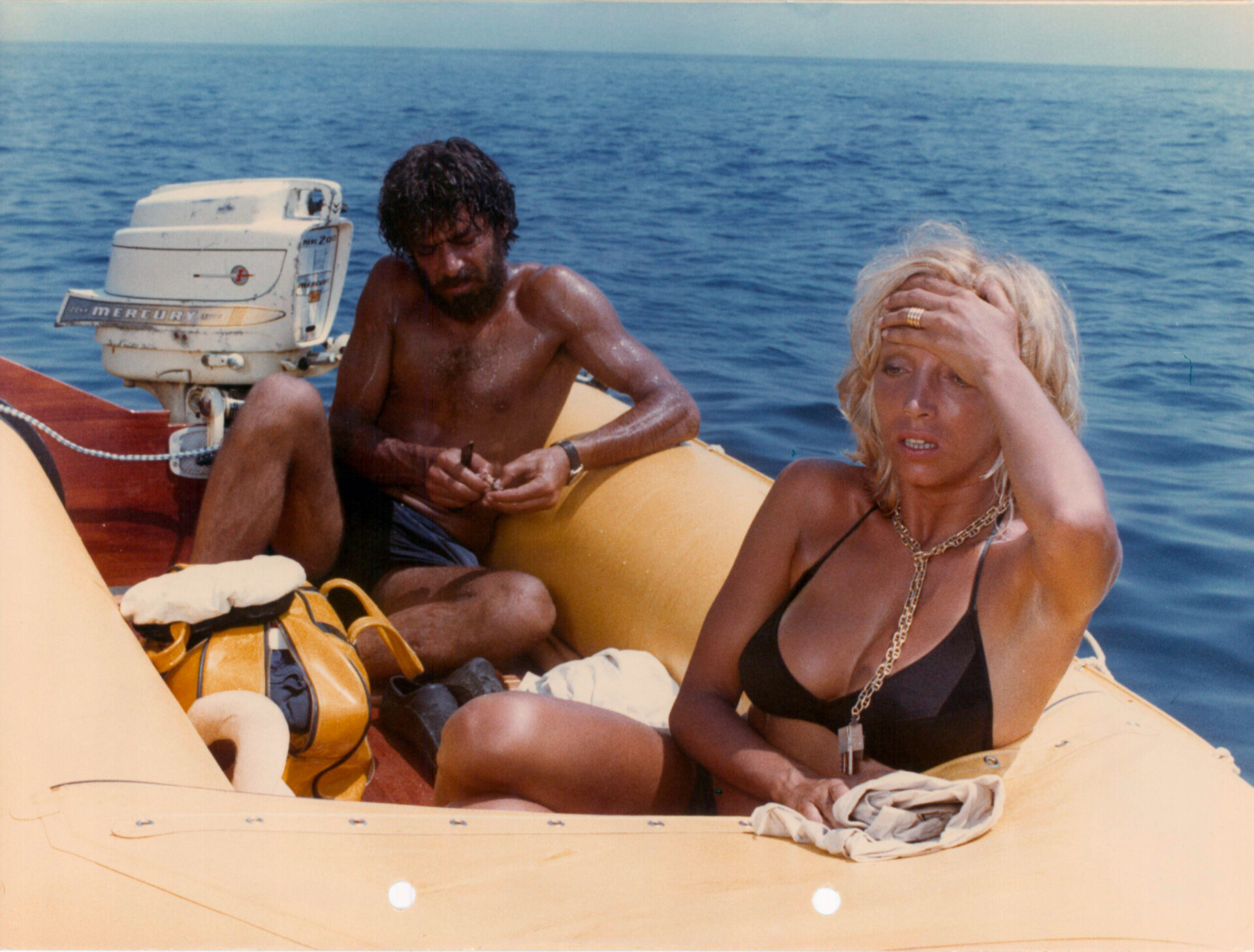
There was a time when popular cinema could also be fiercely political. Few films embody that better than Lina Wertmüller’s Travolti da un insolito destino nell’azzurro mare d’agosto (Swept Away).
Released in 1974, at the height of Italy’s Years of Lead, the film turns an August sailing holiday into a biting allegory of class struggle. After a shipwreck, the wealthy aristocrat Raffaella Pavone Lanzetti (Mariangela Melato) and the communist deckhand Gennarino Carunchio (Giancarlo Giannini) find themselves stranded on a deserted island. Their mutual hostility slowly gives way to desire, as the crystal-clear sea and blazing August sun seem, for a fleeting moment, to dissolve every social divide. Reality, however, proves far less forgiving.
Piero Piccioni’s score mirrors this suspended world with effortless elegance. Brazilian rhythms, lush orchestration, and hypnotic, almost tribal grooves come together to create a dreamlike summer landscape. The music has long outlived the film itself and still feels perfectly at home through a pair of headphones on a sun lounger or beside a swimming pool.
Courtesy of CAM Sugar
La voglia matta (1962)
Music by Ennio Morricone
Summer is also the season of impossible fantasies. In Luciano Salce’s La voglia matta (Crazy Desire), one of the best comedies of the early 1960s, a successful middle-aged businessman (Ugo Tognazzi) finds himself swept away by a carefree group of young holidaymakers, becoming infatuated with the effortlessly magnetic Francesca, played by Catherine Spaak. What begins as a light-hearted summer flirtation gradually reveals itself as a bittersweet reflection on the promises (and illusions) of Italy’s economic boom, when it briefly seemed that all could be rewritten.
Like Dino Risi, Salce excelled at disguising social commentary beneath the surface of comedy. La voglia matta is funny, playful, and effortlessly stylish, yet quietly melancholic, exposing the anxieties of a generation caught between newfound prosperity and the passing of time.
The soundtrack mirrors this duality. The exuberance of jukebox pop and twist records evokes the restless energy of Italy’s youth, while one of Ennio Morricone’s earliest scores reveals a far more intimate side to the film. Tracks such as “Sole e sogni” suspend time altogether, transforming the summer landscape into something dreamlike, fragile, and nostalgic.
Courtesy of CAM Sugar
Profumo di donna (1974)
Music by Armando Trovajoli
Many know this film’s story through its Hollywood remake starring Al Pacino, but the original is unmistakably Italian. Directed by Dino Risi, Profumo di donna (Scent of a woman) reunites the filmmaker with Vittorio Gassman in one of the defining performances of his career. Gassman plays Captain Fausto Consolo, a blind, retired army officer who embarks on a journey across Italy accompanied by a young soldier assigned to assist him. What begins as a reluctant road trip gradually unfolds into a moving portrait of pride, vulnerability, and unexpected companionship.
Armando Trovajoli’s score captures every shade of the film with effortless elegance, shifting between moments of melancholy, flashes of sophisticated funk, and the lyrical warmth that defined his writing. At its heart lies “Che vuole questa musica stasera”, composed by Trovajoli and performed by Peppino Gagliardi. More than a theme song, it has become a classic of Italian popular music: a timeless ballad whose cinematic melancholy has long outlived the film itself, returning to the big screen in works as diverse as Guy Ritchie’s The Man from U.N.C.L.E. and Renato De Maria’s The Ruthless starring Riccardo Scamarcio.
Courtesy of CAM Sugar
La rossa dalla pelle che scotta (1972)
Music by Sante Maria Romitelli
Just as important to the history of Italian cinema are the countless genre films and B-movies that, despite modest beginnings, gradually found devoted audiences and earned cult status. Among them were the softcore comedies and erotic dramas that playfully teased the fantasies of a changing Italy, often with deliciously over-the-top titles such as La rossa dalla pelle che scotta—literally, The Redhead with Burning Skin.
If many of these films have faded into obscurity, their music has done precisely the opposite. Their soundtracks remain hidden treasures, and one of the reasons Italian film music has so often outlived the images it was written for.
Sante Maria Romitelli, a cult composer whose work is only now receiving wider recognition, crafts a score where sensuality and glamour unfold through sophisticated jazz, bossa nova, hypnotic harpsichords, and the unmistakable wordless voice of Edda Dell’Orso, whose ethereal vocals became one of the defining sounds of Italian cinema in the 1960s and ’70s.
Courtesy of CAM Sugar
Le ore nude (1964)
Music by Riz Ortolani
Not every Italian summer happens beneath crowded beach umbrellas or along sun-drenched promenades. Sometimes it takes place indoors, with drawn curtains, where desire and melancholy blur together under the afternoon heat.
Marco Vicario’s Le ore nude follows a young woman, played by Rossana Podestà, as she drifts through Rome in search of independence, intimacy, and a place of her own. More psychological than plot-driven, the film belongs to that remarkable strand of 1960s Italian cinema that elegantly turned the emotional restlessness of its characters into a portrait of a society in full transformation.
Riz Ortolani’s score captures this atmosphere with extraordinary restraint. Gone is the exuberance of the jukebox; in its place are delicate jazz harmonies, airy orchestration, and melodies that seem to dissolve into the summer haze. It’s the type of music that encapsulates the existentialism of summer silence and longing. Listen on a languid afternoon when the heat slows time to a standstill.