In case your feed hasn’t been filled with stars commanding the Lido’s red carpet (hello, Jonathan Bailey and Lifetime Achievement award-winner George Clooney), we’re here to talk about the Venice International Film Festival. This year’s 83rd edition (September 2nd to 12th) has taken over the Palazzo del Cinema with 21 movies competing for the Leone d’Oro (Golden Lion) award.
Other headline-worthy news is Nanni Moretti’s return to the festival after 37 years and Luca Guadagnino’s whopping two-part, seven-hour documentary Joie de Vivre on Bernardo Bertolucci, the first Italian filmmaker to win an Oscar for Best Director. (Fittingly, Bertolucci’s final screenplay is up for the Leone d’Oro award this year thanks to director Andrea Pallaoro.) Keep your eyes also peeled for Wim Wenders’ documentary on architect Peter Zumthor and Francesco Carrozzini’s documentary Be Brave about Diesel founder Renzo Rosso, which is the first Italian full-length feature crafted almost entirely with AI.
So, here’s your front-row preview of the Italian film lineup, the festival, and the city that claims Italy’s cinematic event of the season.
NAVIGATING VENICE
The days of the Venice International Film Festival see an extra 70,000+ visitors flock to the already overcrowded city; to beat the chaos and the crowds, you really have to know where to go. Here, all our insider’s guides to the city.
And here, where to stay whether or not you’re here for festival season.
THE ITALIAN FILM LINEUP
Among the 21 films in the running for the Venezia 83 Competition, five are Italian and premiering at the festival. Here’s the rundown on each:
Succederà questa notte (It Will Happen Tonight); dir. Nanni Moretti
Nanni Moretti returns to Venice after 37 years with a sweeping romance starring Louis Garrel and Jasmine Trinca. He loosely adapted Israeli author Eshkol Nevo’s short story collection A Man and a Woman for this film (his second time adapting a Nevo book, following 2021’s Three Floors). The story is about two people who keep meeting at the wrong moment, until…
Ritorno a Buenos Aires; dir. Marco Bechis
Thirty-three years after exile to Italy, a survivor of Argentina’s dictatorship returns to Buenos Aires to testify against the military captors who abducted and tortured him. Waiting in a safehouse alongside fellow survivors, he’s forced to confront the burden of being one of the few who made it out alive. It’s a deeply personal story for Chilean-Italian director Bechis, who himself was abducted during the Argentine dictatorship 50 years ago.
The Echo Chamber; dir. Andrea Pallaoro
Bernardo Bertolucci’s final screenplay before his death in 2018, this psychological drama follows Leo (played by Italian powerhouse Luca Marinelli) as his retreat to an isolated sanctuary to deal with his addiction is interrupted by two women, Anne (Alicia Vikander) and Ava (Susan Sarandon). Claustrophobic obsession and familial grief drive this rom-dram. It’s Pallaoro’s fourth consecutive feature film to premiere in Venice.
Il fuoco che ti porti dentro (The Fire Within You); dir. Edoardo De Angelis
Years after relocating to Milan to escape his past, Antonio faces a chaotic reunion when his domineering mother unexpectedly arrives for Christmas intending to stay. In this adaptation of Antonio Franchini’s book of the same name, an uncookable capon and a string of uninvited guests turn their holiday dinner into a battlefield of decades-old family grudges.
L’estranea; dir. Paolo Strippoli
This dark thriller follows a mother who suddenly shows up to her adult daughter’s house to make a desperate confession: that her life was brought about through a deal struck with an enigmatic stranger, who has now returned to collect her debt. The high-tension mystery—which the director describes as a “tragedy”—asks, “How much harm are we capable of doing when we mistake it for love?”
The festival lineup might skew heavily male this year, but outside the Lido, there are plenty of female directors dominating Italian cinema. Here are some of our favorites. →
92 YEARS ON THE LIDO
In August 1932, the world’s oldest film festival flickered to life on the terrace of the Hotel Excelsior. The inaugural screening—Rouben Mamoulian’s Dr. Jekyll and Mr. Hyde, with a 9:15 PM showtime—was followed by a grand ball. There was no jury and no official prize: more than 25,000 spectators instead voted for their favorites, naming René Clair’s À nous la liberté best film.
The festival became competitive in 1934, when the Fascist-era Coppa Mussolini awards were introduced. Today’s Golden Lion followed in 1949. By then, the event had moved into the purpose-built Palazzo del Cinema, where films by Fellini, Visconti, Pasolini, and generations of international auteurs would turn the Lido from an exclusive seaside retreat into an annual capital of world cinema.
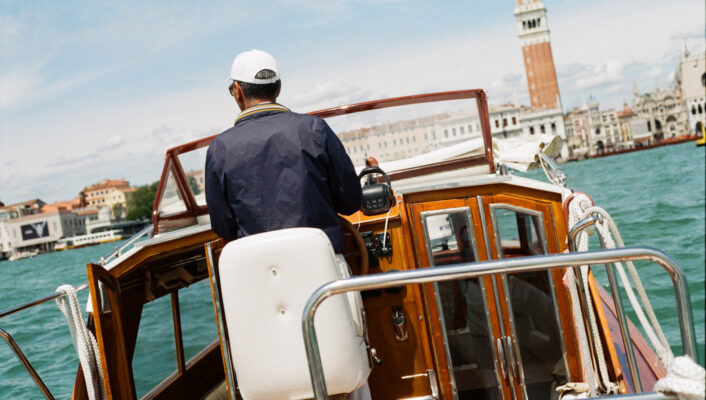
Nearly a century later, Venice remains one of the few film festivals that feels as glamorous as its first edition. Stars arrive by water taxi, the red carpet unfurls beside the Adriatic, and the whole affair retains something of that inaugural night on the Excelsior terrace—a film screening that ended with a ball.