The Uffizi queue starts at 7 AM, packed with tourists brandishing selfie sticks and booking confirmations. Skip it, unless you’re desperate for a photo with the Birth of Venus. The city’s best works are scattered in plain sight, easily visited between a gelato and a glass of wine, located in the places they were designed for during the Renaissance: churches—and their adjoining refectories and convents.
Pass through their doors, and you’ll find a wooden crucifix by Michelangelo in a parish church, frescoes with Masaccio’s revolutionary human emotion, and Pontormo’s startlingly modern brushwork in a chapel by the Ponte Vecchio. With a little planning and a few euros for entry or donation, you can truly understand the Renaissance through the art in these places of worship. And, more often than not, you won’t have to elbow anyone out of the way for face-to-face time with some of Florence’s finest masterpieces.
Cenacolo di Sant’Apollonia: Andrea del Castagno’s Last Supper
This isn’t a church per se, but it’s among my favorite artworks in Florence and being attached to a church, it qualifies. Depictions of the Last Supper are dotted around the city in nondescript refectories, commissioned to look over monks and nuns as they ate their daily meals. This one is by Andrea del Castagno—an artist Vasari falsely accused of murder and whom I like to call the “Anti-Christ of the Renaissance.”
His depiction is set against a vivid trompe l’oeil background, casting the disciples into sharp focus. What sets this apart is the placement of Judas; he sits on the side of the table closest to the viewer, isolated from the others to emphasize his role in Christ’s death. Castagno was meticulous in depicting Judas’s distorted face, rendering him a cruel, calculating being against the introspection of the rest of the table. Keep an eye out for questionable opening hours, but this is one pitstop you should make to see a lesser-known side of the Renaissance.
Basilica della Santissima Annunziata: Frescoes by Castagno, Pontormo, Fiorentino & more
The last time I came here, I unknowingly stumbled into a solemn mass—quite a scene. This is Florence’s most venerated Marian shrine, where local brides still leave their wedding bouquets as an offering to a “miraculous” fresco of the Annunciation. Legend has it that the artist, a 12th-century monk, despairing of his ability to paint a face beautiful enough for the Virgin, fell asleep only to find the work finished by an angel.
I come, however, for the frescoes of our old friend, Andrea del Castagno, whose emotive work remains some of the most striking I know. As usual, Castagno took a standard subject and pushed it to the extreme: his Holy Trinity with Saint Jerome and Two Saints is painted with a jarring realism and a total lack of romanticism. The radical perspective of the Trinity makes it feel as if it might spill off the wall and into the church.
To avoid disturbing the faithful, stick to the Cloister of the “Voti” (formerly a repository for wax offerings*) for a compact “who’s who” of Renaissance Florence. The wax figures were melted down in the 1700s, but the cloister still bears their name, along with frescoes by the city’s greatest Renaissance artists originally commissioned as their backdrop. Though weathered by time, you’ll find works by Andrea del Sarto, Rosso Fiorentino, Pontormo, and Cosimo Rosselli depicting the Life of the Virgin. Collectively, they chart the evolution of style from the High Renaissance to the cusp of Mannerism. Best of all, you’ll likely have them entirely to yourself.
*Known as boti, these were lifelike, full-sized wax statues of people—from popes and kings to ordinary citizens—who left their likenesses here as thanks for answered prayers, once filling the space like a sort of wax museum.
Basilica di Santa Croce: Works by Giotto, Donatello, Brunelleschi & Vasari
While the piazza of the same name outside was where one of the Medici was stabbed to death and where the brutal Calcio Storico still takes place, the church itself offers a far more peaceful narrative. Within this 13th-century basilica lie Giotto’s most masterful frescoes (of Saint Francis in the Bardi Chapel and of Saint John the Baptist and Saint John the Evangelist in the neighboring Peruzzi Chapel) and Donatello’s Annunciation and Crucified Christ—works that demonstrate his skill in raw emotion and startling realism. It’s also the final resting place of Michelangelo, who is buried in a slightly clunky tomb by Giorgio Vasari (who was perhaps a better admirer than he was an artist).
While the Pazzi Chapel, attributed to Brunelleschi and adorned with majolica by Della Robbia, appears a mere architectural addendum, it was actually a turning point for Renaissance architecture. It’s arguably the one church in Florence that makes most clear why the city was the apex of the Renaissance.
Basilica di Santa Trinita: Ghirlandaio’s Adoration of the Shepherds
Positioned squarely among Florence’s most elegant shopping streets—and mere steps from an aperitivo at Procacci—Santa Trinità is the church I find myself revisiting time and again. I typically enter with a singular mission: a beeline for the Sassetti Chapel in the right transept.
While the frescoes at Santa Maria Novella are grand statements of Ghirlandaio’s genius, this chapel is a more nuanced testament to his intellect. The prominent banker and his wife who commissioned the project demanded the best money could buy (some things never change), and what they got was a space designed by an artist keenly aware of how paintings imported from Belgium were reshaping the Florentine Renaissance. The central altarpiece, the Adoration of the Shepherds, echoes Hugo van der Goes’ Portinari Altarpiece, which had arrived from Bruges just three years prior (now a highlight of the Uffizi). Ghirlandaio translates those meticulously realistic Flemish sensibilities in a Florentine way, layering references to Roman antiquity. Keep an eye out for Ghirlandaio’s self-portrait: he’s the shepherd on the far right, pointing toward the manger while looking directly at the viewer. Even the surrounding marble tombs are encoded with symbolism; it is well worth the time to see what secrets you can decipher for yourself.
Basilica di Santa Maria Novella: Ghirlandaio’s frescoes in the Tornabuoni Chapel
Santa Maria Novella may now be more widely recognized for the perfume brand that shares its name, but even if you’re visiting for the perfumes and elixirs, please spare a moment to go inside the church. Behind its patchwork green-and-white marble facade lies a staggering collection of art, from Giotto’s monumental crucifix to Masaccio’s Holy Trinity—the first application of linear perspective in Renaissance painting.
The true centerpiece, however, is Ghirlandaio’s Tornabuoni Chapel. No expense was spared by Giovanni Tornabuoni, another powerful banker and rival to the Medici, in a spectacular instance of artistic one-upmanship. Rather than a purely religious cycle, it serves as a sophisticated portrait of 15th-century Florence masquerading as biblical history. Scenes from the lives of the Virgin and Saint John the Baptist are staged against classical backdrops and the medieval streets of the city. Most of the figures are not anonymous bystanders but portraits of the Tornabuoni family and the Florentine elite (including the artist himself). If you want to see how people lived in Florence 500 years ago, this is it.
Basilica di Santo Spirito: Michelangelo’s crucifix (his first work)
You likely know this church by its piazza—arguably the most lively in Florence. On any given evening, the church steps serve as an impromptu grandstand for university students and lovers alike. Yet, behind its characteristically nondescript facade lies a compelling story of firsts and lasts.
This was the final design of Filippo Brunelleschi, representing his architectural vision at its most refined; the simple design of gray pietra serena against white walls is an early masterclass in monochrome. The church also houses what is commonly accepted as the first work of Michelangelo: a slender, wooden crucifix. His Christ is captured still alive, with haunting realism in the final moments of life.
There’s a long-standing rumor that this anatomical precision was inspired by Michelangelo’s secret dissections of corpses in the Santo Spirito hospital—but being a stickler for historical accuracy, I couldn’t possibly comment.
Chiesa di Santa Maria del Carmine: Masolino and Masaccio’s frescoes in the Brancacci Chapel
You don’t come here for the church; you come for the Brancacci Chapel. And yes, you really do need to book in advance, and yes, you must turn up exactly on time (trust me). This chapel represents a seismic convergence of key figures from the early Renaissance. It features the work of Masolino, followed by his protégé Masaccio, whose rendition of Adam and Eve Expelled from Eden remains a turning point in the depiction of raw human emotion. It is also widely cited as the first instance where nudity was rendered with such unflinching accuracy. Nearby, Masaccio’s Tribute Money is another splendid example of linear perspective in Florentine art—a work so influential that Michelangelo is reputed to have studied it closely.
Look for the faint seams in the plaster called giornate, which mark exactly how much Masaccio finished in a single day; they show just how fast he had to work to finish his scenes before the wet wall dried.
Chiesa di Santa Felicita: Pontormo’s The Deposition from the Cross
Just beside the Ponte Vecchio, Santa Felicita is famously linked to the Uffizi and Pitti Palace by the Vasari Corridor—the elevated passageway that allowed the Medici to attend Mass without ever setting foot on the public streets.
Inside the Capponi Chapel hangs Pontormo’s The Deposition from the Cross (1528), the altarpiece that fractured the stability of the High Renaissance and signaled the birth of Mannerism. It’s a mind-swirling melee of acid-pastel pinks, blues, and greens, populated by distorted, elongated figures. Christ’s body appears almost weightless, supported by figures twisting in poses that defy both logic and traditional perspective. Even today, the work feels startlingly modern, as if it could have been painted by a contemporary hand. And that is why the Renaissance will forever be relevant.
Basilica di San Miniato al Monte
The journey to San Miniato al Monte is what truly distinguishes it from Florence’s other churches. Perched high above the city, it is the landmark you see crowning the Oltrarno hills, drawing you upward through the scent of the rose gardens at dawn or dusk. This church dates to the 11th century, and the facade to the 13th, and remains a functioning Olivetan monastery. There are no “masterpieces” here, only a mastery of technique, from the patterned marble floors to the shimmering 13th-century mosaic in the apse and the majolica altarpiece of Della Robbia. If you visit toward evening, the harmony of the monks’ Gregorian vespers creates an almost transcendent atmosphere. Emerging afterward to find the panorama of Florence laid out at your feet is a moment unsurpassed.
Basilica di San Lorenzo: Michelangelo’s tombs for the Medici princes
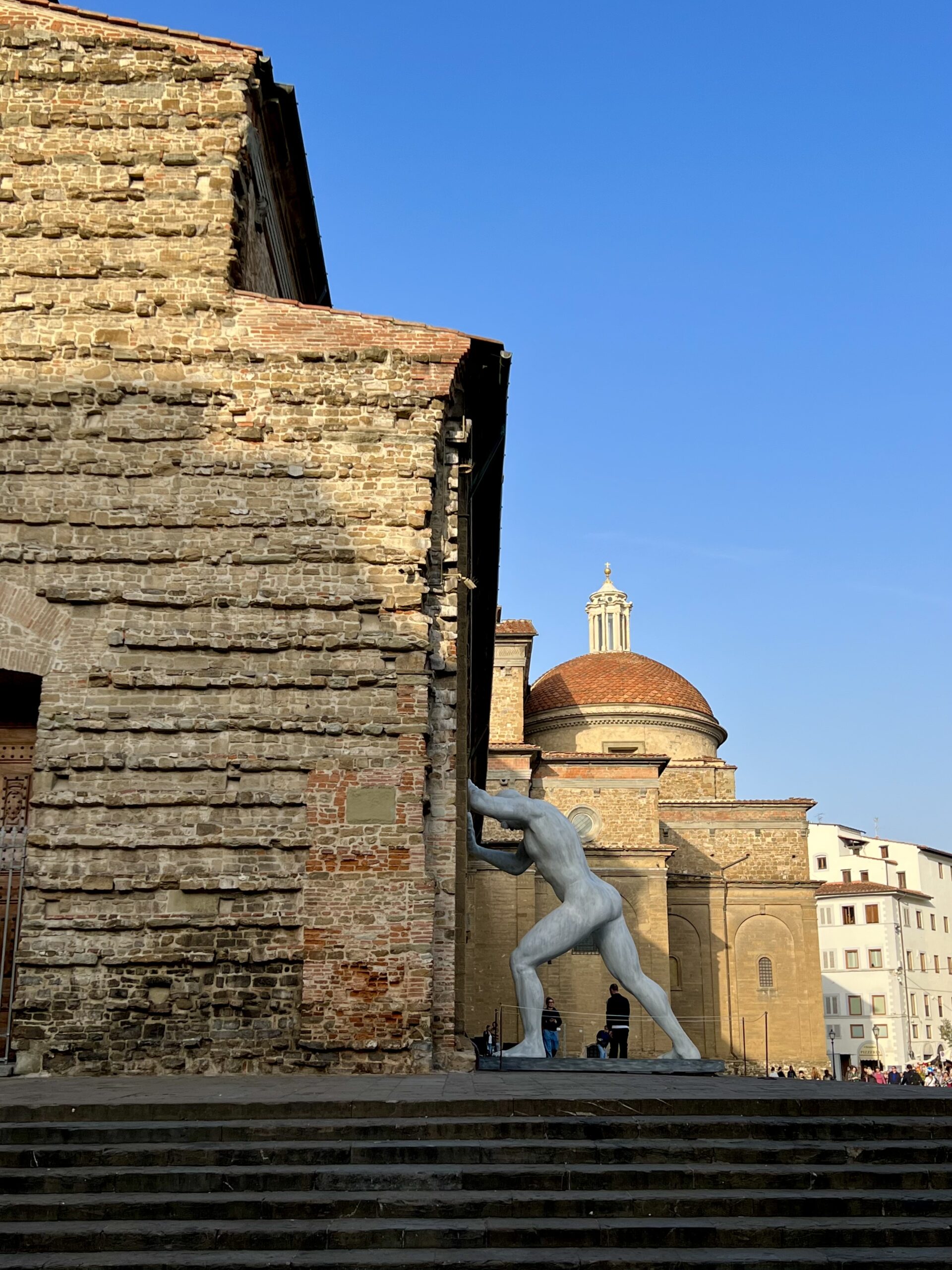
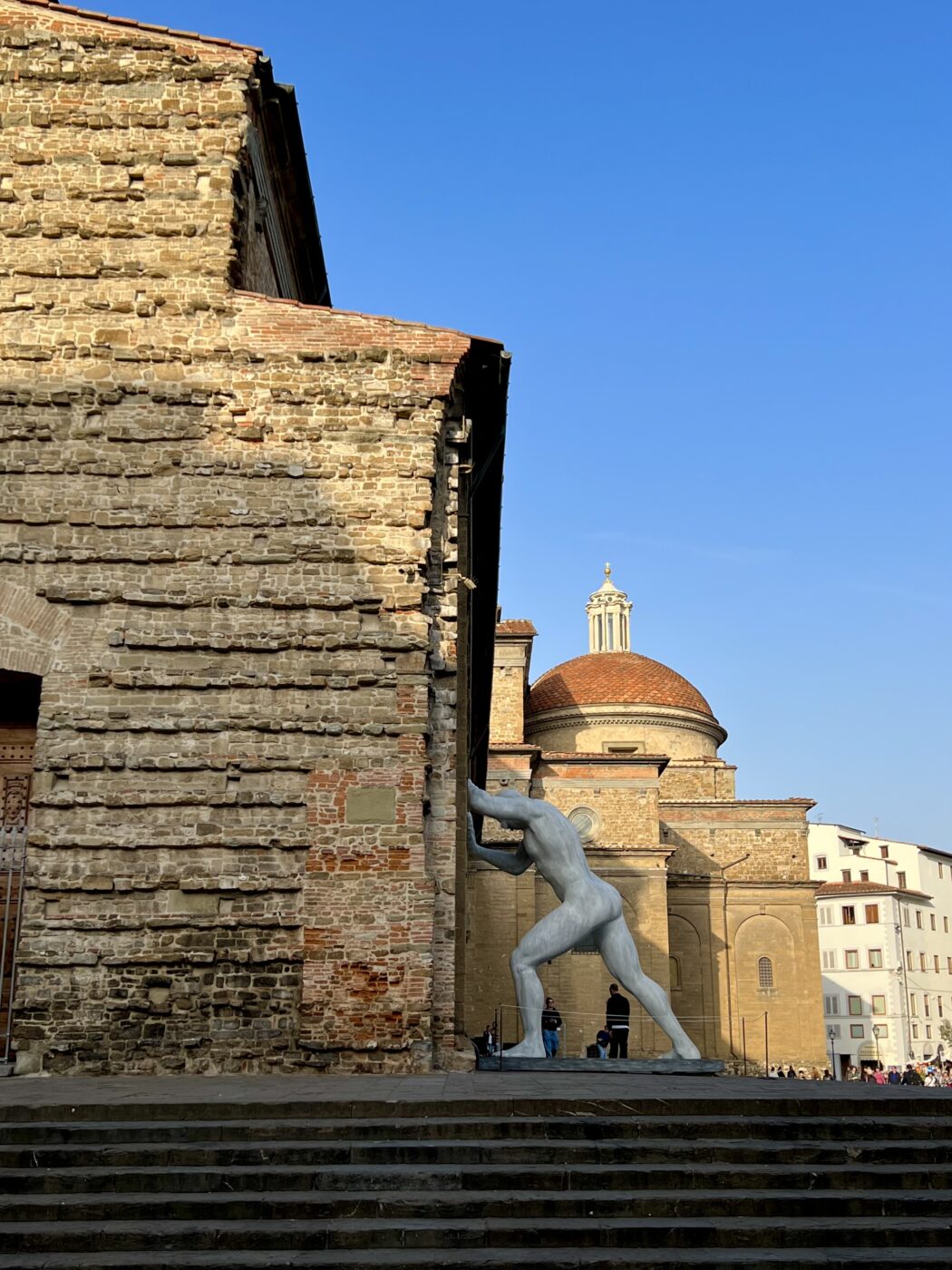
San Lorenzo’s bare brick frontage might be the plainest of all Florentine churches, but it was intended to be the most magnificent. Michelangelo spent nearly two decades obsessing over the facade, eventually calling his creative block the “curse of San Lorenzo”—a struggle evidenced by the increasingly complex designs now housed in museums worldwide. What he didn’t do for the exterior, however, he achieved inside. Head to the New Sacristy in the Medici Chapels, and you’ll find perhaps the most complete realization of Michelangelo’s artistic vision.
Commissioned to house the tombs of the Medici princes, the ambitious chapel features some of his finest sculptures, including beautiful personifications of Night and Day. This church is also where Michelangelo hid during the Siege of Florence, and there’s graffiti by his hand on the walls to prove it.