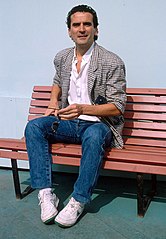
If Maradona had been born in San Giorgio a Cremano, he would have been the Massimo Troisi of football. He would have been even more a hero of Campania, belonging to those colors by birth, and his way of playing would have been no less celebrated. We wouldn’t have said that he embodied Neapolitan football; we would have simply said that he embodied football itself.
The same is often said of Massimo Troisi—that as an actor, director, and screenwriter, he told the story of Naples in the 1980s. And it’s true. But he didn’t tell only the story of Naples, nor just that of his generation. Troisi started from Naples at a difficult moment—perhaps a turning point in its history—and exported to the rest of Italy something that had never been staged before, something in which many recognized themselves. His style was an innovation, above all a cultural one. He presented a Neapolitan protagonist far from cliché: shy yet sharp, impatient yet overwhelmed by events, unable to decide, riddled with doubts—the very same doubts many of us still carry today.
His strength, as both actor and director, lay in his refusal of excess. He didn’t search for the abnormal or the exaggerated; instead, he brought the quiet sobriety of everyday life to the screen. In those moments, Troisi became all of us. Those of us who stutter during an important speech, who interrupt one sentence to begin another, who hunt for the right words with our eyes and hands. In the 1980s, it was commonly said that his cinema captured the reality of young people in Campania better than many documentaries. He could just as easily have spoken of Turin, Umbria, or Calabria—his message would have arrived with the same force, because the emotions he staged were, and remain, shared by young Italians everywhere.
Troisi never looks like he’s acting. His fragmented, pause-filled language—marked by hesitations and stutters—is spontaneous. It’s ours. It’s the language we use with friends, colleagues, lovers. A language made of silences and gestures, unmistakable expressions, and cumbersome reflections on the meaning of life. The themes he tackled remain uncannily current, even forty years on: love, work (and the lack of it), the difficulty of expressing feelings, the struggle for emancipation and personal fulfillment. Troisi is universal. We are all, in some way, a little Troisi.
He also revolutionized how Naples was perceived in mass culture, dismantling stereotypes with wit and intelligence.
“I’m marginalized twice. When people know you’re Neapolitan, they’re prejudiced—they think you’re cunning, that you want to take advantage. But if you’re Neapolitan and shy, if you keep to yourself, then you really disappear.”
With lightness and precision, he exposed Italian contradictions, addressing thorny topics—from faith to politics—without ever losing his gentleness. He joked about the untouchable San Gennaro and the Annunciation in the legendary sketches with La Smorfia, about the tears of the Madonna in Scusate il ritardo. He skewered fascism in Le vie del Signore sono finite, poked at President Sandro Pertini in Morto Troisi, viva Troisi!, and even touched on U.S. foreign policy during a television interview with Pippo Baudo.
Troisi also reclaimed Neapolitan as a living, expressive language, spreading it far beyond its borders—much like his close friend Pino Daniele did with music. “I think and dream in Neapolitan. When I speak Italian, I feel fake,” Troisi once said. Perhaps that’s why he never seemed to act. “I make an effort to speak Italian—so you make an effort to understand Neapolitan!”
At the start of his career, this choice was bold, even risky. At a time when dialect was steadily disappearing from Italian cinema, Troisi risked narrowing his audience. Instead, he achieved the opposite: he made Neapolitan popular and intelligible, understood well beyond its geography. His expressiveness went far beyond words—his voice, gaze, gestures, pauses, and magniloquent face formed an inseparable whole. For this reason, his language remains unmatched and universal, even when dialectal. Though he once lent his voice to Pino Daniele’s “Saglie, Saglie,” Troisi was never a performer whose voice could stand alone. It was inseparable from his image—part of a singular presence in Italian cinema and theater.
Music, too, was central to his world. Three of his films were scored by Pino Daniele, who also set Troisi’s poem ’O ssaje comme fa ’o core to music. Interviewed by Gianni Minà, Troisi once described their collaboration simply: “He writes the songs, then he calls me and says, ‘Will you make me the film?’ And we’ve been doing it like that for years.”
They called him the “comedian of feelings,” but even that label falls short. For Troisi, “comedian” sounds reductive—as it would for figures like Alberto Sordi or Paolo Villaggio, who, like him, knew how to make people laugh and move them with equal intensity.
“I’ve accomplished three things in my life—why should I start again from scratch? I want to start from three.”
Troisi’s comedy existed beyond its time. Forty years later, it still hasn’t aged. He knew how to identify human weaknesses, the smallest quirks and uncertainties we take for granted, and turn them into something gently humorous. He possessed that very Campanian gift of never taking himself too seriously, while always telling the truth. Perhaps we should all learn something from him: to be a little more Troisi—to use irony, to smile, and to keep going, lightly, honestly, as best we can.