Many Italian food stories begin in the dawn of time; but in the case of the Easter colomba, there’s no “once upon a time”, but rather a precise date, a first name, and a surname. The colomba that all Italians eat at Easter is, in fact, a modern dessert, born from a (some might say genius) marketing idea. It was invented by an advertiser, not a pastry chef, exactly 90 years ago.
Italy is a young country, united in 1861 and having become what it is today only after World War II, which is why each region and city preserves a heritage of recipes and traditions so diverse. Historically, Easter is a time for cooking plenty of eggs, rich breads, and stuffed savory pies; lamb and kid are traditional staples, but nowadays, the colomba takes center stage on supermarket shelves and in every pastry shop. A soft, leavened bread with a dough similar to panettone but without raisins, colomba’s dough is studded with candied orange peel and its surface covered in crunchy glaze and almonds.
It is baked in a paper mold—just like panettone—but shaped like a dove, the symbol of Easter and of peace. In its classic version, the colomba has become an artisanal phenomenon on par with panettone, even if it carries slightly less hype (abroad too) and lower national consumption. Today, like panettone, it is reimagined in a thousand variations, featuring chocolate or pistachio creams and creative fillings. The latest trends even see it go savory, in hybrids with Neapolitan casatiello or Abruzzese cheese bread.
Almost every Italian family eats at least one colomba during the Easter period. However, few realize that it was invented by Motta in 1936—the same Milanese confectionery giant that invented panettone as we know it today: tall, encased in a paper mold, and mass-produced.
“Jack squat! That’s what you’d be eating if we hadn’t invented panettone,” read one of Motta’s ads, sarcastically, in 2019.
In the 1930s, Motta’s Propaganda Office (what, today, we would call marketing) was led by Dino Villani. A true Renaissance man, born in 1888 in the Verona area, Villani was a painter, engraver, and art critic who became the pioneer of what we now call integrated communication and strategic marketing.
At the time, his mission was to transform panettone from a local Milanese specialty into the Christmas dessert for all Italians. To do this, he created a dedicated prize for the Giro d’Italia, commissioning a panettone so massive that news cameras were forced to frame it.
The stunt worked. Motta thrived and production soared, but there was a problem: once Christmas ended, the company would come to a near halt. To keep the machines running and the dough rising year-round, Villani had an idea: a new dessert that utilized the exact same machinery and base ingredients as panettone but that could be sold even after Christmas time.
And so the colomba was born. “The cake that tastes of spring,” read the launch posters, marking the debut of a new tradition.
In an interview before his death in 1989, Villani told Giovanni Ballarini of the University of Parma, that folk traditions were one thing, but a national icon was another: “…dove-shaped sweets have been well known in Italy since ancient times; no one can deny that. Undoubtedly, not once, but thousands upon thousands of times, a housewife, a baker, or even a pastry chef in the days leading up to Easter has made a biscuit or a cake in the shape of a dove, especially if it was for a special Easter. This was an occasional occurrence, which is very different from an organized, systematic, and comprehensive production—from the shape, name, and confectionery composition to, above all, the distribution.”
“Who invented the automobile?” he continued. “Many built a tricycle or a quadricycle with an engine, but the true inventor of the automobile was Henry Ford, who was the first to give the car to everyone, just as I did with the Motta Colomba.”
The colomba was born industrial and only later became artisanal, when small shops, chasing the success of the product, began to offer it as well, but handmade. Today, it is an unshakeable Italian Easter tradition.
“Does that bother you?” Ballarini asked in the interview.
“On the contrary, I was happy that others followed the path I started in the mid-1930s. Even in 1944, at the height of the war, it proved the importance of a good dessert—something capable of providing a moment of pleasure and, more importantly, a sense of hope,” Villani replied. “I’m thinking specifically of Angelo Vergani, who started producing colombe in a small pastry shop on Viale Monza in Milan, as well as all the other companies that helped turn the Easter Colomba into a dessert that signals ‘Italian identity’ even abroad.”
In his memory, an award was established, the “Dino Villani Prize,” given to those “who distinguish themselves in promoting Italian food products of the highest quality.”
But the colomba was just one feather in his cap. Villani was a relentless innovator who invented much more, even within gastronomy, thanks to his relationships with the companies, journalists, and intellectuals of the era.
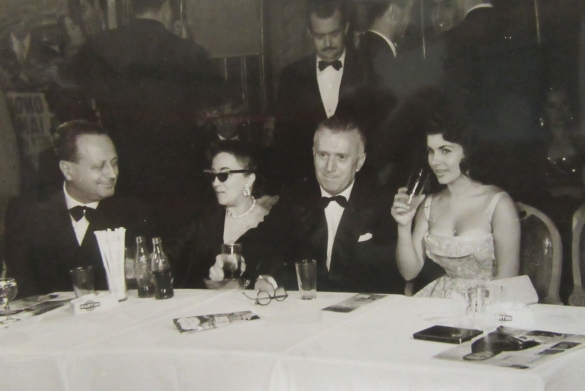
The jury table at Miss Italia with Dino Villani (first on the left); Courtesy of Collezione Biblioteca Comunale G.D. Romagnosi
In 1939, when the dream for most Italians was to earn “a thousand liras a month” as the famous song went, Dino Villani and writer Cesare Zavattini launched the “Cinquemila lire per un sorriso” (“Five Thousand Liras for a Smile”) contest.
“We are looking for the most beautiful smiles in Italy,” the announcement read, inviting contestants to send in a photo of their smiling faces; it was to promote a toothpaste brand. This birthed Italy’s first beauty pageant, which later became Miss Italy, of which Villani served as patron until 1959.
His influence on Italian culture continued: in 1958, he invented Mother’s Day, and in 1962, he imported Valentine’s Day. In 1953, alongside journalist Orio Vergani, he founded the Academy of Cuisine to promote national food culture abroad. Finally, in 1964, he organized the first group of 12 restaurants committed to territorial cuisine, requiring them to offer, year-round, a signature dish that served as a “rigorous and exemplary representation” of their local tradition.
While high-end restaurants of that era were mostly inspired by French cuisine and trattorias promised home-style cooking, the Buon Ricordo (“Good Memory”) restaurants began championing traditional cuisine, zero-kilometer ingredients, and niche products—precursors to today’s biggest trends.
But the great idea, unchanged since then, was the signature dish, the one exemplary specialty of the territory on the menu of every participating restaurant. Anyone who ordered it received a hand-painted ceramic plate as a gift—a “good memory” of the meal that became a viral marketing tool avant la lettre.
To ensure these plates were truly coveted, they had to be artisanal rather than industrial. The master ceramists of Vietri sul Mare were chosen to decorate each piece of terracotta by hand, one by one. The initiative was a massive success, spreading from the North across the entire peninsula; by 1977, a dedicated Collectors’ Association was formed.
Nearly every Italian remembers these plates hanging on kitchen and trattoria walls, collected like a sticker album to show off one’s culinary knowledge. They still exist today, having become a classic, much like the colomba itself.
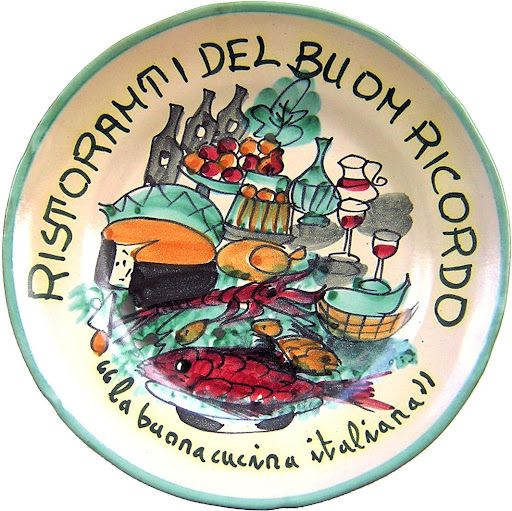
One of the "Good Memory" plates